
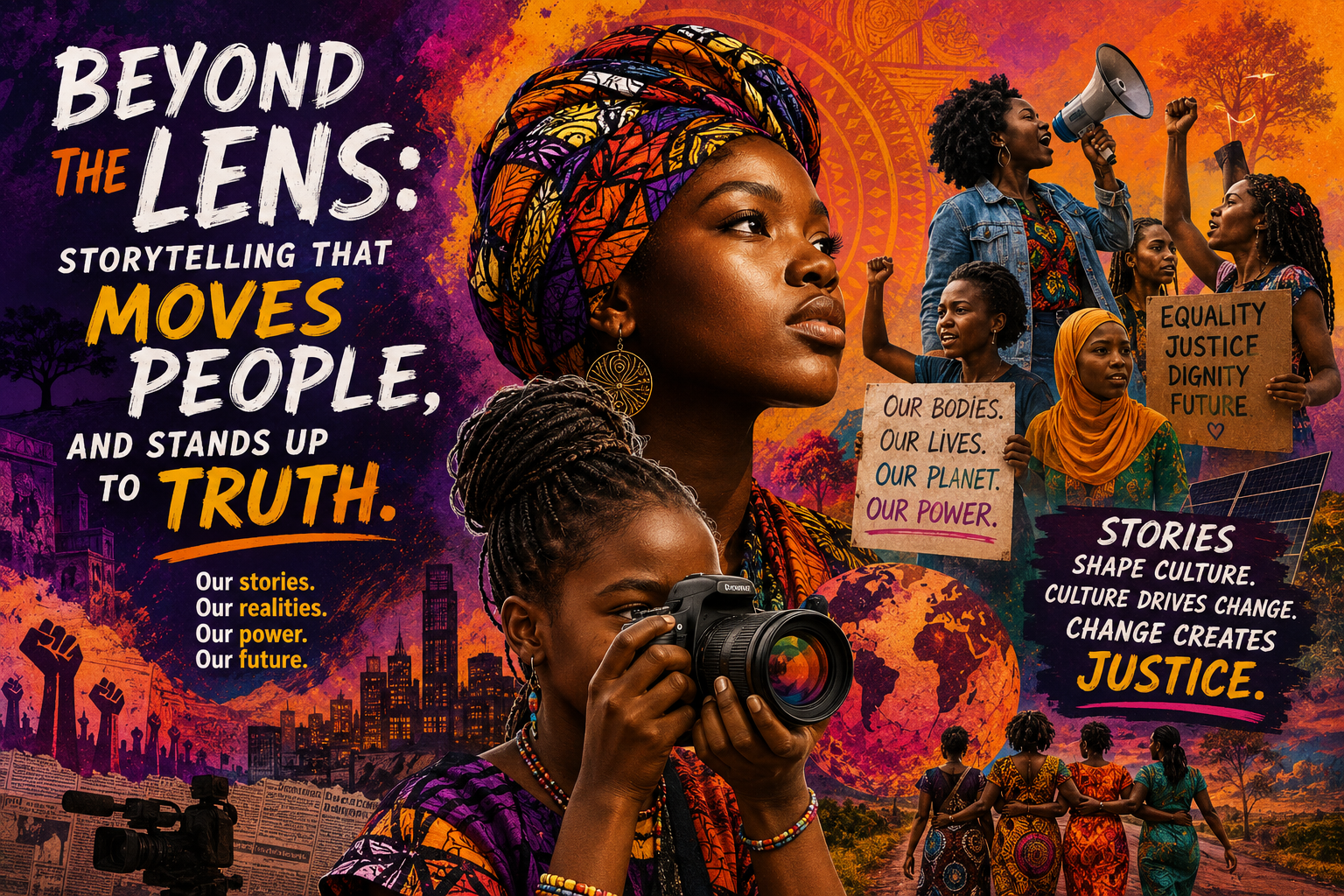
Beyond the Lens: Storytelling That Moves People, and Stands Up to Truth
There are sessions you attend, and then there are sessions that quietly rearrange how you see your work. The storytelling workshop hosted by CARE International on the sidelines of the Women Deliver Conference was the latter.
It did not begin with theory. It began with a question that lingered long after the room settled: Who is your story really serving?
As communications professionals in the social impact space, we often pride ourselves on telling powerful stories—stories of resilience, of survival, of progress. But somewhere along the way, storytelling can become extractive. Polished narratives risk flattening lived realities. Urgency can overshadow dignity. And impact can become something we measure in impressions rather than in actual change.
This workshop challenged that instinct firmly, but constructively. It reminded me that storytelling, at its core, is not about visibility. It is about responsibility.
Centering Women’s Leadership: From Subjects to Story Owners
The most powerful insight I carried with me is this: stories that move people to action are not necessarily the loudest; they are the most honest. They center people not as subjects of intervention, but as leaders of their own narratives. Especially women.
Centering women’s leadership in storytelling is not just about representation; it is about shifting power. It is about asking: Are women speaking for themselves in our narratives, or are we still speaking about them? Are we amplifying agency, or unconsciously reinforcing vulnerability as the dominant lens?
In that room, it became clear that the stories that cut through are the ones that trust women with the fullness of their experiences, the complexity, the contradictions, the courage. And that is where the real work begins.
From Complexity to Connection: Translating Realities Without Losing Truth
Because translating complex realities into human narratives is not easy. Development work is layered with policy language, data, and systemic challenges. It is tempting to simplify to make stories more “digestible.” But the workshop pushed us to resist oversimplification and instead lean into clarity without losing depth.
A mother navigating climate shocks is not just a statistic on food insecurity. A young woman advocating for her rights is not just a beneficiary of a program. When we tell their stories well, we do not reduce their experiences; we reveal the systems around them. We connect the personal to the political. We make the invisible visible.
And most importantly, we help audiences see themselves within the story, not as distant observers, but as participants in change. That is where storytelling becomes catalytic.
Ethics in the Age of AI: Telling Stories We Can Stand By
But there was another layer that stayed with me, perhaps the most urgent one in today’s evolving communication landscape: the role of Artificial Intelligence.
AI is increasingly becoming part of how we tell stories, especially when we need to recreate scenes that cannot be easily filmed or safely captured. In humanitarian and development contexts, there are moments we cannot document in real time: conflict situations, deeply personal experiences, or environments that pose risks to both the storyteller and the subject.
Here, AI offers possibilities, but also demands discipline. Used well, AI can help us visualize realities without exposing individuals to harm. It can recreate environments, simulate scenarios, and support storytelling where the camera cannot go. It can help bridge gaps between lived experience and audience understanding. But it also raises critical ethical questions.
If we recreate a scene, are we being transparent about it? Are we maintaining fidelity to the truth of that experience, or are we unintentionally dramatizing it? Are we protecting the dignity of the people whose stories we are telling—or replacing their voices with constructed interpretations?
The workshop reinforced that AI should not become a shortcut for storytelling; it should be a support system for ethical storytelling. It must be guided by the same principles we expect from any narrative: consent, accuracy, dignity, and accountability.
Because when audiences engage with a story, they are not just responding to what they see—they are responding to what they believe to be true. And trust, once broken, is difficult to rebuild.
To tell stories that move people to action, we must ensure that even when technology is involved, the humanity of the story remains intact. AI should enhance understanding—not distort it. It should protect people, not replace them.
As I reflect on this session, I find myself rethinking the way I approach storytelling not as a tool, but as a practice. One that requires intention at every stage: whose voice is centered, how the story is framed, what action it calls for, and what impact it ultimately creates.
In many ways, this workshop was a call to return to the basics—but to do so with greater depth. To listen more than we speak. To co-create rather than extract. To tell stories that are not only compelling but also accountable.
Because in the end, storytelling for development is not about telling better stories. It is about telling truer ones. And in a world where both narratives and technologies are evolving rapidly, the real challenge—and responsibility—is to ensure that truth is not the first thing we compromise in the process of trying to be heard.
