
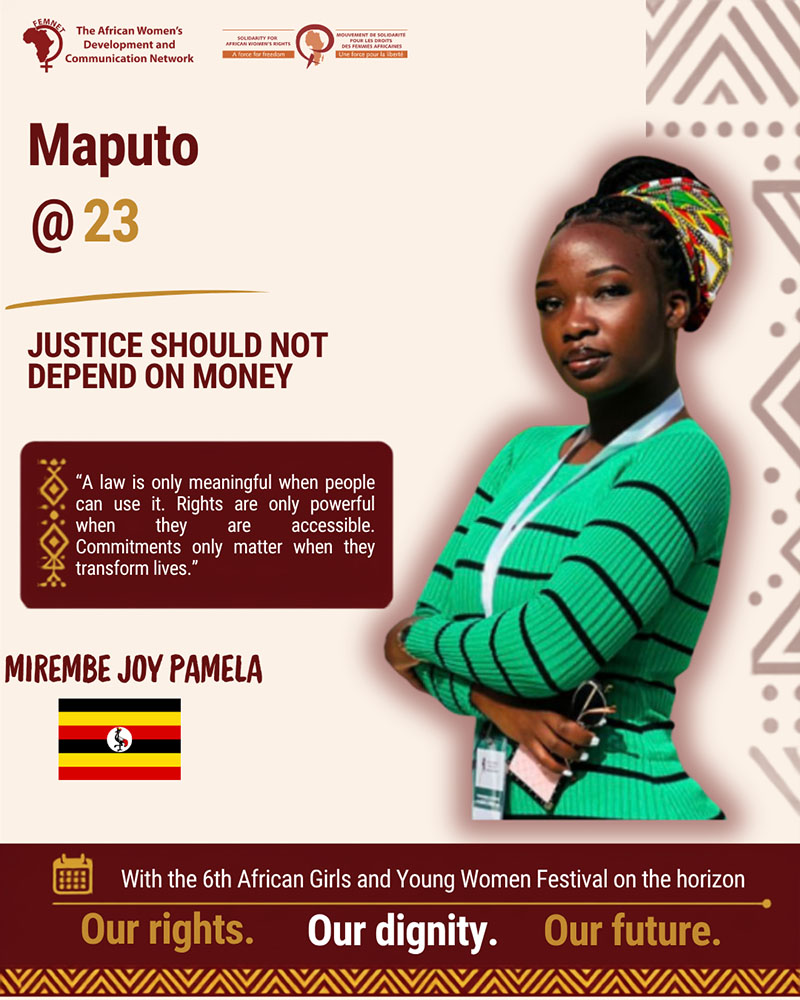
Justice Should Not Depend on Money
Article 8: Access to Justice and Equal Protection Before the Law
Twenty-three years after the adoption of the Maputo Protocol, one question continues to trouble me: what does justice mean to a girl who cannot afford it?
As a Girls and Young Women (GYW) Advocate from Uganda, I have listened to the concerns of young women who know that something wrong has happened to them but do not know where to seek help or believe they will ever receive justice. Some are discouraged by the cost of transport to police stations or courts. Others fear being judged, blamed or ignored. Some give up because the legal process feels too complicated, too expensive or too far away. Their experiences remind me that justice is not truly justice if it is only accessible to those with money, influence or connections.
Article 8 of the Maputo Protocol guarantees women equal protection before the law and the right to access justice. This means that every woman and girl, regardless of her age, income, education, disability or location, should be able to report violations, seek protection and receive fair treatment. Justice is a right, not a privilege.
For many girls and young women in Uganda, however, this promise is still far from reality.
Imagine a young woman living in a rural community who experiences gender-based violence. The nearest police station may be many kilometres away. She may need transport money that she does not have. Even when she reaches the station, she may face questions that make her feel ashamed instead of supported. She may be encouraged to settle the matter at home rather than seek formal justice. If her case reaches court, delays can last months or even years. During this time, she may lose hope, face pressure from family or community members, or decide that seeking justice is too difficult.
These are not only legal barriers. They are barriers to dignity, healing and equality.
Girls and young women often face additional challenges because of economic inequality and gender discrimination. Many depend financially on parents, guardians or partners. Some are still in school, while others work in informal employment with limited income. Paying for transport, legal advice or repeated visits to follow up on a case can become impossible. For girls living with disabilities, young mothers or those in marginalized communities, these barriers can be even greater.
Access to justice is about more than courts. It begins with knowing your rights. Many girls have never been taught about the protections available to them under national laws or the Maputo Protocol. Without awareness, rights remain promises on paper. Schools, communities and youth organisations have an important role in ensuring girls understand their rights and know where to seek support.
As a GYW Advocate, I believe empowering girls with knowledge is one of the strongest ways to create change. When girls know their rights, they are more likely to speak out, challenge discrimination and support one another. But knowledge alone is not enough. The systems created to protect them must also be accessible, responsive and fair.
Justice institutions must serve everyone, especially those who are most vulnerable. Police officers, prosecutors, judges and local leaders should receive training on handling cases involving women and girls with professionalism, empathy and respect. Survivors should never be blamed for the violence committed against them. Their voices deserve to be heard and taken seriously.
Governments also have a responsibility to strengthen legal aid services. Free or affordable legal support should not only be available in major cities. Every girl, regardless of where she lives, should be able to access legal information, counselling and representation when needed. Community-based legal services, youth-friendly reporting systems and stronger support networks can help bridge the gap between laws and reality.
Civil society organisations also play a critical role. Across Uganda, many organisations work to provide legal support, raise awareness and advocate for the rights of women and girls. Their work reminds us that change is possible when governments, communities and young people work together.
Families and communities must also challenge attitudes that encourage survivors to remain silent. Protecting family reputation should never come before protecting a girl’s dignity and safety. Silence does not create justice. Supporting survivors does.
As we celebrate 23 years of the Maputo Protocol, we must recognize both the progress made and the work that remains. A law is only meaningful when people can use it. Rights are only powerful when they are accessible. Commitments only matter when they transform lives.
I dream of a Uganda where no girl decides not to report violence because she cannot afford transport. I dream of police stations where survivors are welcomed with compassion instead of suspicion. I dream of communities where girls are believed, protected and empowered to seek justice.
Justice should never depend on the size of someone’s wallet, their social status or where they live. Every girl and young woman deserves equal protection before the law, equal dignity and an equal opportunity to be heard.
Twenty-three years after the adoption of the Maputo Protocol, the question is no longer whether women and girls deserve justice. They do. The question is whether we are ready to remove the barriers that prevent them from accessing it.