
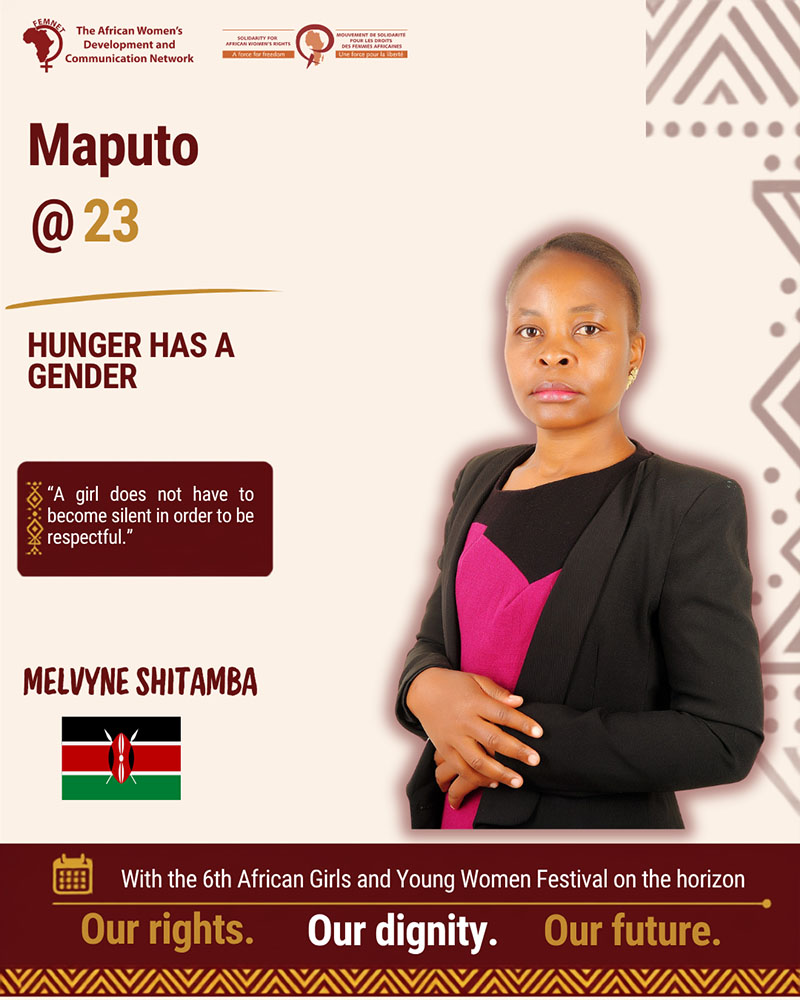
Hunger has a Gender
Introduction
In Kenya, hunger is not a gender-neutral crisis. It is a deeply gendered issue, where women, who form the backbone of the agricultural sector bear a disproportionate burden of food insecurity. Constituting between 70% and 80% of the agricultural labor force, women are the primary producers of food, yet they are systematically denied the resources needed to thrive. With fewer than 5% holding individual land titles and facing significant barriers to credit and financial services, women are trapped in subsistence farming, while a lack of decision-making power leaves their needs, including prenatal nutrition, systematically overlooked.
This vulnerability is severely amplified by climate change. In Kenya, where droughts and erratic rainfall have become the norm, women are on the front lines, walking longer distances searching for water and firewood as resources dwindle. Studies in Makueni County reveal that while adaptation strategies like conservation agriculture boost food security for men, women-headed households are less likely to adopt these measures and, even when they do, are less likely to benefit, demonstrating that climate adaptation is failing them. The consequences are devastating: hunger drives girls out of school and into early marriages or transactional sex for survival. This complex intersection of gender inequality, climate vulnerability, and systemic exclusion ensures that hunger remains a crisis primarily carried by Kenya’s women and girls.
Areas that show hunger is gendered
Education
In Kenyan schools, dropout cases are frequently reported, with the main trigger being hungry girls missing school to fetch food or water. Families pull girls out of school first when fees compete with meals. Additionally, in menstrual management cases, when girls go without food, their energy drops and periods may stop or become irregular, adding stigma and absenteeism.
Economic and Time Burden
Invisible labor is a significant factor, with Kenyan women spending over four hours daily foraging and cooking, time not spent on income or rest. Young women and girls have also been seen eating last in the family, particularly in patriarchal households where women reduce their own portions first during scarcity, eating 25–30% less than men. Asset stripping has been witnessed where crises force families to sell girls in exchange for livestock or dowry, eroding their future financial security.
Protection and Safety
Young women and girls opt for survival sex, where hunger drives them into transactional sex or early marriage for food, especially when famine spikes. Violence at homes is another issue, as food stress increases domestic abuse, leading to women skipping meals to calm angry, hungry husbands. Exploitative labor has been experienced in homes where girls are pulled into hazardous work like domestic servitude over boys when food runs out.
Policy and Systems
Climate shocks due to droughts hit women hardest because they rely on rain-fed subsistence crops, not cash crops that men control. Young women and girls are excluded from decision-making, leading to being left out of food-ration committees and other critical policy spaces.
Psychological
Shame and anxiety are experienced in many cases, where mothers blame themselves for not feeding children, leading to depression and reduced caregiving. Aspiration loss is yet another factor, as chronically hungry girls lower their future expectations, settling for smaller lives earlier.
Practical solutions with case studies that are working in Kenya
Women-Led Climate-Smart Farming
The Makueni Paradox and why Context Matters. A 2025 study of 521 households in Makueni County reveals a critical nuance: standard climate-smart strategies do not always work equally for women. Planting drought-tolerant crops and changing planting dates improved food security for male-headed households, but for female-headed households, the same strategies reduced their food security. The root cause: women face barriers such as lower education levels (50% of female heads had no formal education versus 22% for men), lack of collateral for credit, and limited market access. Without these supporting factors, even the right farming techniques can fail them.
With the establishment of cooperatives in Makueni, the Kimatwa Women SACCO, with over 700 members, adopted drought-tolerant maize, beans, sorghum, and green grams using planting basins that boosted yields from 20kg to 90kg per plot. They bought a shared tractor and run a seed-revolving scheme so members can replant each season.
Gender-Responsive Design
In Garissa, a pastoralist and ASAL region, there is a need for task specialization in dairy goat systems where women do feeding, cleaning, and watering, but men control breeding, marketing, and 58.7% of enterprise decisions. Training women in business skills, as Kimatwa SACCO now does, using the Women’s Milk Cooperative Model, shifts that power balance. It has worked to address cash flow and asset gaps, with women pooling milk sales, accessing loans for school fees, and diversifying into goat trading. This is evident in the Modogashe Women’s Cooperative, which is now packaging yogurt and running hotels.
On the climate burden, 86.6% of young females fetch water during droughts, taking time from school. To address this, the government should focus on digging boreholes, rainwater harvesting, and father-to-father and mother-to-mother support groups; a model World Vision is applying that promotes shared chores.
Urban and Informal Settlements
In Nairobi, “the Dishi na County” digital school meals model removes the cost barrier. Parents pay KSh 5 per meal via mobile money, subsidized by Nairobi County partners, making it affordable to most parents. Evidence shows that the model addresses urban food insecurity and keeps girls in school with reliable daily nutrition.
Message For Maputo
The evidence is undeniable: hunger in Kenya is not a natural disaster, it is a structural failure of gender justice. Women grow 80% of our food, yet own less than 5% of our land. They feed our families, yet eat last and least. They adapt to climate change, yet our solutions fail them.
Maputo 23 must mark a turning point. We cannot afford another declaration that ignores the woman walking four hours for water, the girl trading her body for a meal, or the mother skipping hers to calm a hungry husband.
Let us commit to land rights for women, not as charity, but as justice. Climate finance that reaches female-headed households, not just those with education and collateral. School meals that keep girls in class, because a fed girl is a girl who dreams. Decision-making seats for women in every food committee, every cooperative, every policy table.
The solution is not more studies. It is action. It is resources. It is political will. Let Maputo 23 be remembered as the moment we stopped asking What works? and started asking What works for her?
Because hunger has a gender. And so must our response.
Feed her. Fund her. Include her. End hunger.