
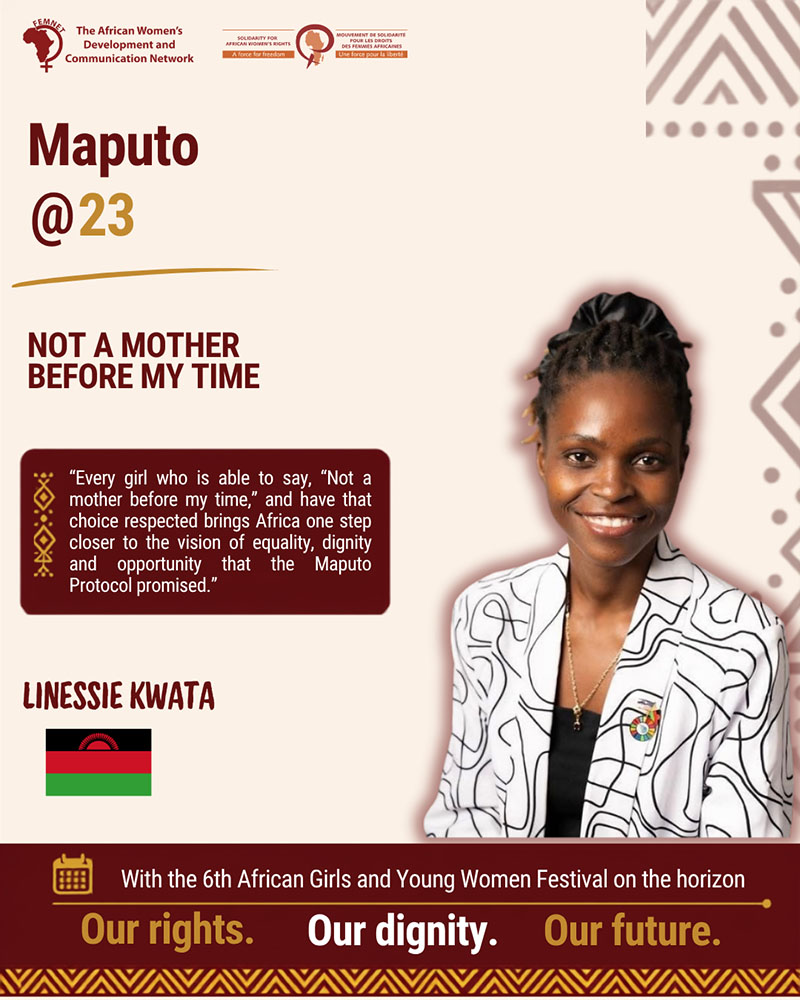
Not a Mother Before My Time
Every anniversary of the Maputo Protocol offers an opportunity to reflect on Africa’s progress in advancing women and girls’ rights and the work that remains.
For millions of African girls, one simple plea captures what the Protocol represents in Articles 12 and 14: Not a mother before my time.
No girl should have her childhood interrupted by child marriage, unintended pregnancy or harmful social norms that force her into adulthood before she is ready. She should be in school, discovering her potential, building her future and making decisions about her own life.
The adoption of the Maputo Protocol marked a defining moment for women’s and girls’ rights across Africa. Through Articles 12 and 14, African governments recognised that gender equality cannot be achieved if girls are denied quality education or prevented from making informed decisions about their health. These provisions affirm that education and health are inseparable from freedom, dignity and justice.
These commitments deserve recognition, but commemoration should also inspire honest reflection. Promises only matter when they transform people’s everyday lives regardless of sex.
Across Africa, many girls continue to face barriers that prevent them from completing their education. Child marriage, unintended pregnancies and inadequate support continue to interrupt dreams that should never be determined by one’s sex.
In Malawi, although progress has been made in increasing girls’ enrolment, many still struggle to complete their education because harmful social norms continue to define their worth through marriage and motherhood rather than education and achievement. Through my work with Together We Rise Foundation, I continue to meet girls who seek help because families or community members pressure them into marriage. These actions rob girls of their futures and undermine the vision of equality established in Article 12.
When girls stay in school, they are more likely to delay marriage and motherhood, earn better incomes, enjoy improved health and contribute to stronger families, communities and economies. Yet too many girls are still forced to overcome barriers simply to exercise their right to education. How much longer must girls fight for rights that already belong to them?
The same concern applies to Article 14.
Health is not merely the absence of disease. It is the ability to live with dignity and access the information and services needed to make informed decisions about one’s life.
The Protocol guarantees women’s rights to reproductive healthcare, family planning information and services, maternal healthcare and reproductive autonomy. These protections recognise that decisions about one’s body belong to the individual, not to harmful traditions, social expectations or discriminatory practices.
Yet for many girls and young women, these rights remain difficult to access. In Malawi, adolescent girls and young women continue to face barriers when seeking family planning information and services. Fear of judgement from healthcare providers, families and communities discourages many from accessing care. Harmful stereotypes portray young women seeking contraception or sexual and reproductive health services as immoral or irresponsible, limiting access and increasing vulnerability to unintended pregnancies that can force girls out of school and into early motherhood.
Many young women I interact with explain that fear of being labelled immoral prevents them from accessing family planning methods and condoms. This is a clear sign that more must be done to ensure young women can access accurate information and essential services without stigma.
No girl or young woman should have to choose between protecting her health and protecting herself from shame. A girl who cannot access appropriate healthcare may be forced to leave school. A young woman denied accurate information may lose opportunities that could have shaped her future. Early motherhood often limits educational attainment, economic independence and personal aspirations, reinforcing cycles of poverty and inequality that affect communities.
This is why Articles 12 and 14 remain so important.
Education and health reinforce one another. A healthy girl is more likely to stay in school. An educated girl is better equipped to understand her rights, make informed choices about her body and decide if, when and under what circumstances she wants to become a mother; that choice should always be hers.
Progress depends on ensuring that girls receive knowledge instead of silence, support instead of exclusion and investment instead of neglect.
The responsibility to uphold the Maputo Protocol extends beyond governments. Schools, healthcare systems, families, traditional leaders, civil society organisations and communities all have a role in turning legal commitments into lived realities.
Young women themselves must also be recognised as partners in shaping the policies that affect their lives. Their experiences provide important insights into the barriers that remain and the solutions needed to create lasting change.
As we commemorate the Maputo Protocol, we should remember that its true strength lies not only in the rights it proclaims but also in the action it inspires.
Every girl who remains in school instead of becoming a child bride gives life to Article 12.
Every young woman who can access respectful, quality reproductive healthcare gives meaning to Article 14.
Every girl who is able to say, “Not a mother before my time,” and have that choice respected brings Africa one step closer to the vision of equality, dignity and opportunity that the Maputo Protocol promised.
Until every girl can make that choice freely, Africa still has work to do.