
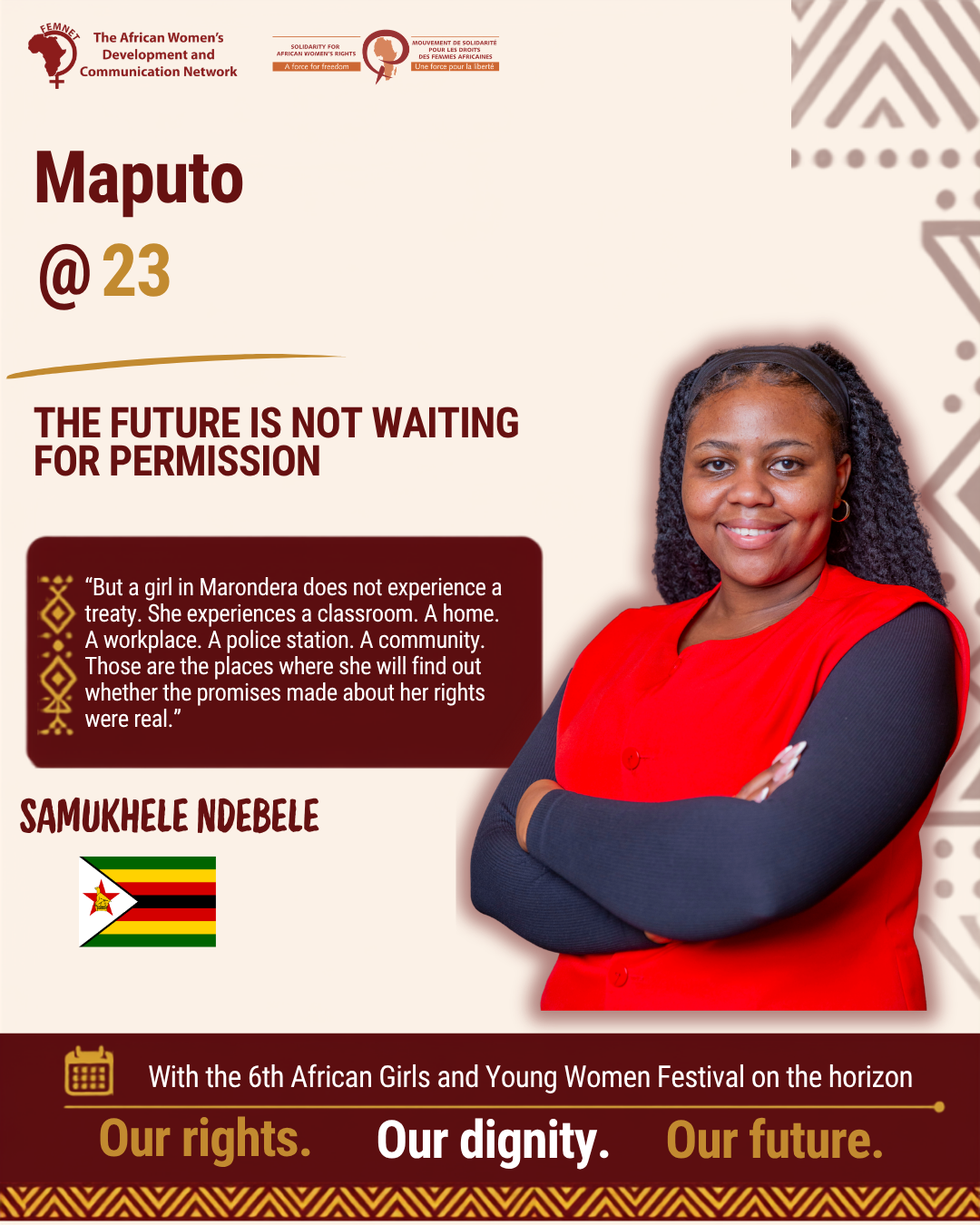
The Future is not Waiting for Permission
To me, the future is not waiting for permission means that life continues whether girls and young women are given equal opportunities or not. Twenty-three years after the adoption of the Maputo Protocol, its promises are still not the lived reality of most young women and girls in Marondera, a small town 74 kilometres from Zimbabwe’s capital city.
And perhaps that is what bothers me most. We have become very good at telling girls what they can be. You can be a lawyer. You can be an engineer. You can be a leader. You can be independent. Of course they can be all those things. Why does my being a woman have to be part of the disclaimer?
Article 2 of the Maputo Protocol asks States Parties to do more than prohibit discrimination. It calls for a change in the social and cultural patterns that teach us that women and men have particular roles to occupy. That part feels especially important to me because some of the things that limit women do not always look like discrimination. Sometimes they look like ordinary advice. Sometimes they look like culture. Sometimes they look like concern for what is “appropriate” for a woman. And those ideas follow us into adulthood.
In my community, I have seen how easily a woman’s economic dependence can become a limitation on her voice. When you are not the one bringing money into the household, it can become difficult to challenge the person who is. It is difficult to make decisions independently when your ability to do so is tied to someone else’s income. Article 9’s promise of participation therefore cannot only mean putting women in rooms where decisions are made. It must also mean creating the conditions that allow women to enter those rooms with enough power to actually speak.
That is where Article 19 becomes especially relevant. Development is not just about whether a country is growing. What does development mean to a young woman who has been taught to prepare for a future she has little control over? What does it mean to tell girls to dream when the resources, opportunities and economic independence needed to pursue those dreams are not equally available to them?
There is another kind of waiting that concerns me, the waiting that happens when young women enter workplaces and discover that having a right does not necessarily mean knowing how to exercise it safely.
I have heard stories of young women being approached or harassed by men in positions of authority. What happens when the person making you uncomfortable is also the person who has influence over your employment? You can report it, but to whom? What happens if you are not believed? What happens if speaking up makes your working life more difficult than remaining silent?
This is where Article 26 becomes more than a reporting obligation. It forces us to ask what implementation actually looks like. Zimbabwe has laws, constitutional protections and international commitments. There has been progress. But research on the implementation of the Maputo Protocol in Zimbabwe has also identified the gap between legal commitments and the realities women experience, including the effects of limited political will, inadequate resources and deeply rooted patriarchal attitudes.
For me, that is the uncomfortable part of marking 23 years of the Maputo Protocol.
We have the language. We have the commitments. We have the laws. But a girl in Marondera does not experience a treaty. She experiences a classroom. A home. A workplace. A police station. A community. Those are the places where she will find out whether the promises made about her rights were real.
So I am less interested in asking whether girls and young women have permission to enter the future.
We are already in it.
The more important question is, what kind of future are we building if girls are still expected to wait for permission to fully participate in it?