
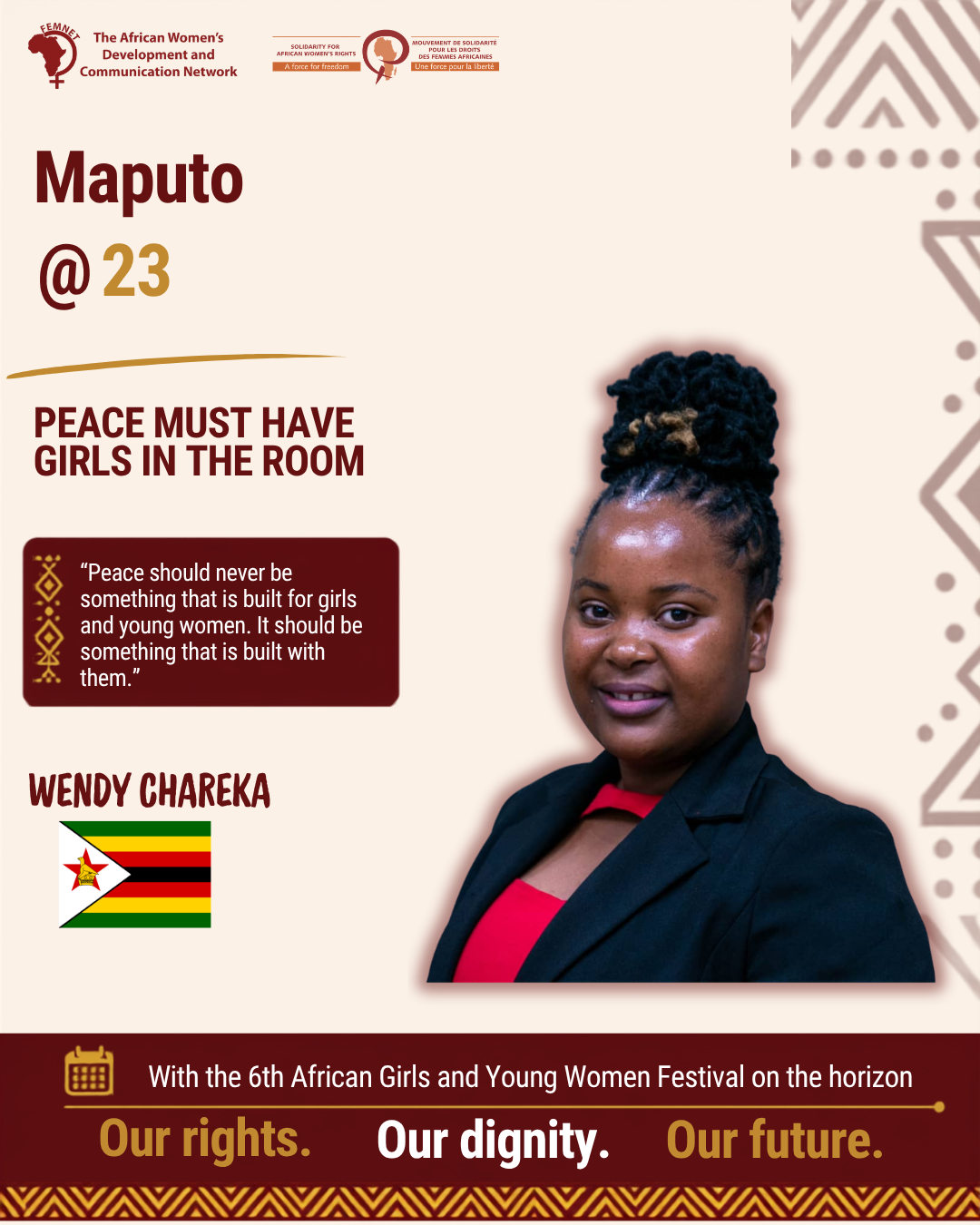
Peace Must Have Girls in the Room
When we talk about peace, we often think about the absence of war. But peace is more than that. It is about justice, being heard, having equal opportunities and creating a society where everyone, regardless of age or gender, has a chance to contribute to the decisions that shape their future.
Article 10 of the Maputo Protocol reminds us that women have the right to live in peace and to participate in promoting and maintaining it. It also calls on governments to ensure that women participate in conflict prevention, peacebuilding and decisionmaking at all levels. This means that women and girls should not only benefit from peace; they should also have a seat at the table where peace is discussed and decisions are made.
But on the ground, this is not always the reality.
From Sudan, South Sudan, South Africa, Zimbabwe and the Democratic Republic of Congo, conflict continues to affect the lives of women and girls the most. Many have lost their homes, their education and their sense of security. They are expected to rebuild their communities, yet their voices are often missing from the very decisions that shape those communities.
This raises a simple question: How can we build lasting peace when we continue to leave girls and young women behind?
The conversation about peace should not only be for countries experiencing armed conflict. Even in countries like Zimbabwe, peace should also be measured by whether people are free to speak, participate and influence decisions that affect their lives.
Zimbabwe’s Constitution is clear. Section 17 calls for gender balance. Section 56 guarantees equality and freedom from discrimination. Section 80 recognises the rights of women and calls for equal opportunities in political, economic and social life. These are important commitments, but they must go beyond the Constitution and be reflected in the everyday lives of women and girls.
Many young women in Zimbabwe continue to face barriers that limit their participation. Some are intimidated or arrested for speaking out on issues affecting their communities. Others are labelled as troublemakers simply for demanding accountability or justice. Many are still told that they are too young to lead or that leadership is not their place.
When this happens, we are not only silencing their voices; we are weakening our democracy and our chances of building lasting peace.
Peace cannot exist where people are afraid to speak. It cannot exist where young women are punished for asking questions or challenging injustice. It cannot exist where decisions are made for women and girls without women and girls.
Across Zimbabwe, young women are already leading. They are advocating for climate justice, gender equality, education, health and accountable governance. They are organising their communities, finding solutions and shaping conversations. What they need is not permission to lead. They need equal opportunities, protection and the chance to influence decisions that affect their lives.
Article 10 of the Maputo Protocol remains as relevant today as it was when it was adopted. It reminds us that peace is strongest when it includes everyone. Governments, institutions and communities all have a responsibility to create safe and meaningful spaces where women and girls can participate fully.
As Africa continues to strengthen democracy and promote gender equality, we must move beyond making commitments on paper. We must protect civic space, invest in young women’s leadership and ensure that women and girls are represented wherever decisions are made.
Peace should never be something that is built for girls and young women. It should be something that is built with them.
Because if peace is to last, then girls must be in the room.