
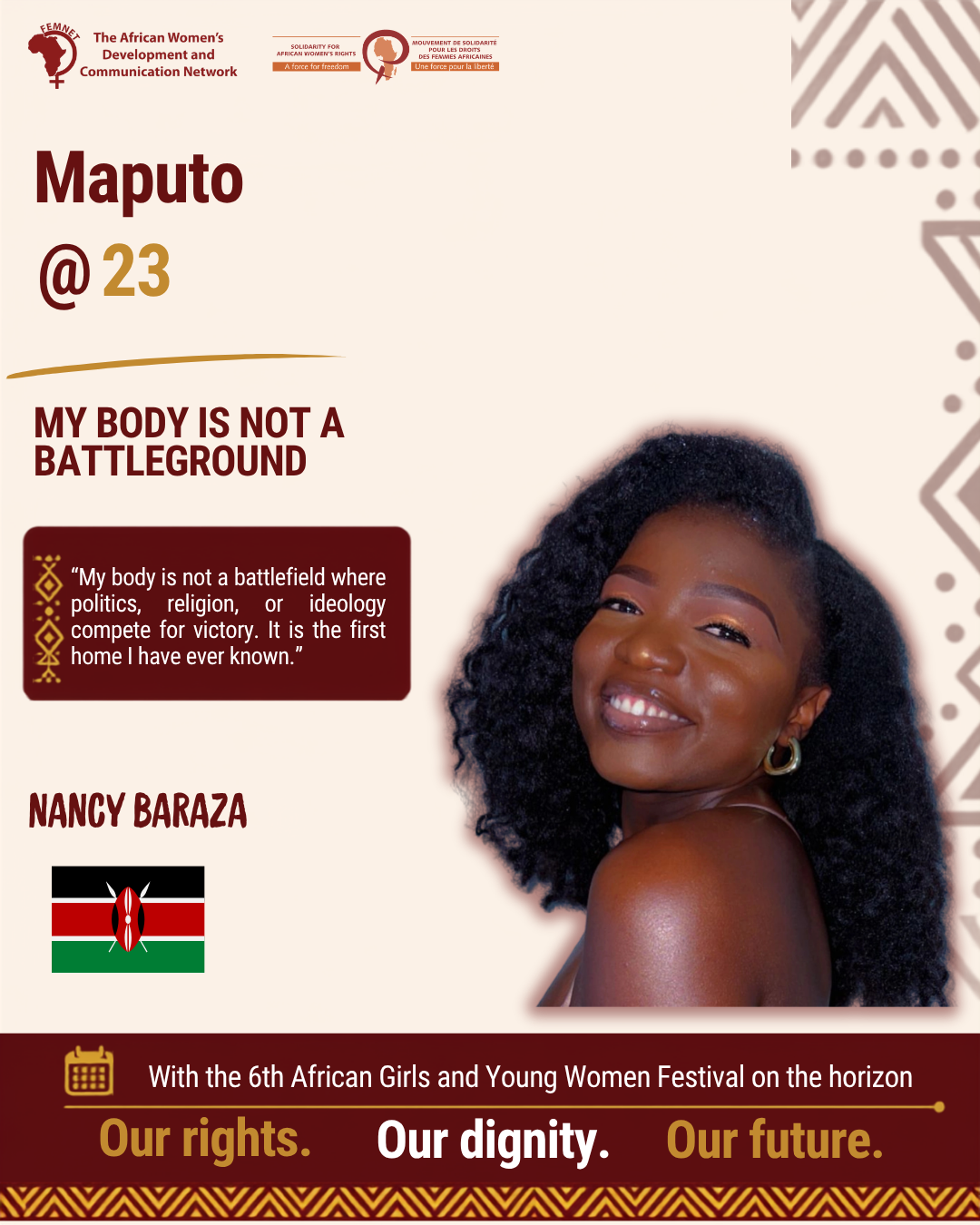
My Body Is Not a Battleground
By Nancy Barasa
There is something strangely fascinating about being a woman.
Not because of biology or motherhood, but because everyone seems to have an opinion about our bodies. From the moment a girl begins to grow into herself, her body becomes a political debate, a Sunday sermon, a family discussion, and a cultural battleground. Apparently, my uterus has a larger advisory committee than most government ministries.
As we commemorate 23 years of the Maputo Protocol, we celebrate more than a landmark legal instrument; we celebrate one of Africa’s boldest declarations that the rights, dignity, and bodily autonomy of women and girls are fundamental to the continent’s future. Adopted by African
Union Member States in 2003, the Protocol affirmed that reproductive rights, equality, freedom from violence, and access to healthcare are not foreign ideals but African commitments.
Twenty-three years later, it remains both a symbol of African feminist leadership and a reminder that its true legacy will be measured not by the treaties we signed, but by whether every woman and girl can live with dignity, justice, and freedom.
I grew up in Kibera, one of Africa’s largest informal settlements. Long before I understood the language of bodily autonomy, I understood what it felt like for girls’ bodies to carry burdens they never chose. Our conversations were rarely about dreams. They were about purity, respectability, pregnancy, and reputation. Girls quickly learned that our bodies belonged, in one way or another, to everyone else.
Years later, working in Sexual and Reproductive Health and Rights (SRHR), I thought those conversations would become more nuanced. The rooms changed. The suits became sharper. The microphones became more expensive. But the question remained the same: Who gets to decide what happens to a woman’s body?
For a long time, I believed the answer lay in reproductive rights: whether abortion was legal, contraception was available, or Comprehensive Sexuality Education was taught in schools.
Those conversations matter, but I eventually realized they were answering the wrong question.
Rights on paper mean little if women cannot exercise them in practice.
That is why the concept of reproductive justice, developed in 1994 by twelve Black women in the United States, resonated so deeply with me. Their framework expanded the conversation beyond legal rights to include the right to have children, not have children, and raise children in safe and dignified communities. It recognised that poverty, discrimination, and unequal access to healthcare often determine whether a choice is truly a choice.
Growing up in Kibera, I witnessed this reality every day. A young woman should never have to choose between buying a meal and travelling to a health facility. She should not delay treating a simple infection because survival demands impossible trade-offs. That is not choice. That is inequality disguised as choice.
One of the most exhausting arguments I encounter is that bodily autonomy or reproductive rights are somehow “un-African.” Yet Africa has already answered that question. Through the
Maputo Protocol, African states affirmed women’s rights to dignity, health, bodily integrity, and reproductive healthcare. This is not a foreign agenda. It is an African commitment made to
African women.
The challenge has never been imagining a just future. It has been finding the political courage to implement it.
Over the years, I have watched anti-rights movements become increasingly organised and sophisticated. Their language often centres on protecting children, preserving culture, and defending family values. Those aspirations sound noble until we ask one simple question:
Protected from what, and at whose expense?
Too often, girls disappear from the conversation. The adolescent seeking contraception becomes an ideological argument. The survivor of sexual violence becomes a political talking point. The woman seeking safe abortion becomes a moral debate. The real lives of women are eclipsed by abstract ideas about what our bodies are supposed to represent.
I have sat in those rooms. I have seen evidence drowned out by ideology. I have watched global policies like the Global Gag Rule shape what services are available in local clinics and create fear among organisations providing reproductive healthcare. I have also seen legal uncertainty force women to repeatedly defend rights they thought had already been recognised. It often feels less like expanding rights and more like protecting ground that has already been won.
Yet I remain hopeful.
Hope lives in young feminists refusing to be silenced, healthcare providers offering compassionate care, lawyers defending constitutional rights, teachers creating safe spaces for honest conversations, and communities choosing empathy over fear. They remind me that resistance is not always loud. Sometimes it is simply insisting that every woman deserves dignity.
My body is not a battlefield where politics, religion, or ideology compete for victory. It is the first home I have ever known.
It is not territory to be conquered.
It is not a campaign slogan.
It is not a symbol.
It is a human life.
And human lives deserve more than debates.
They deserve dignity.