
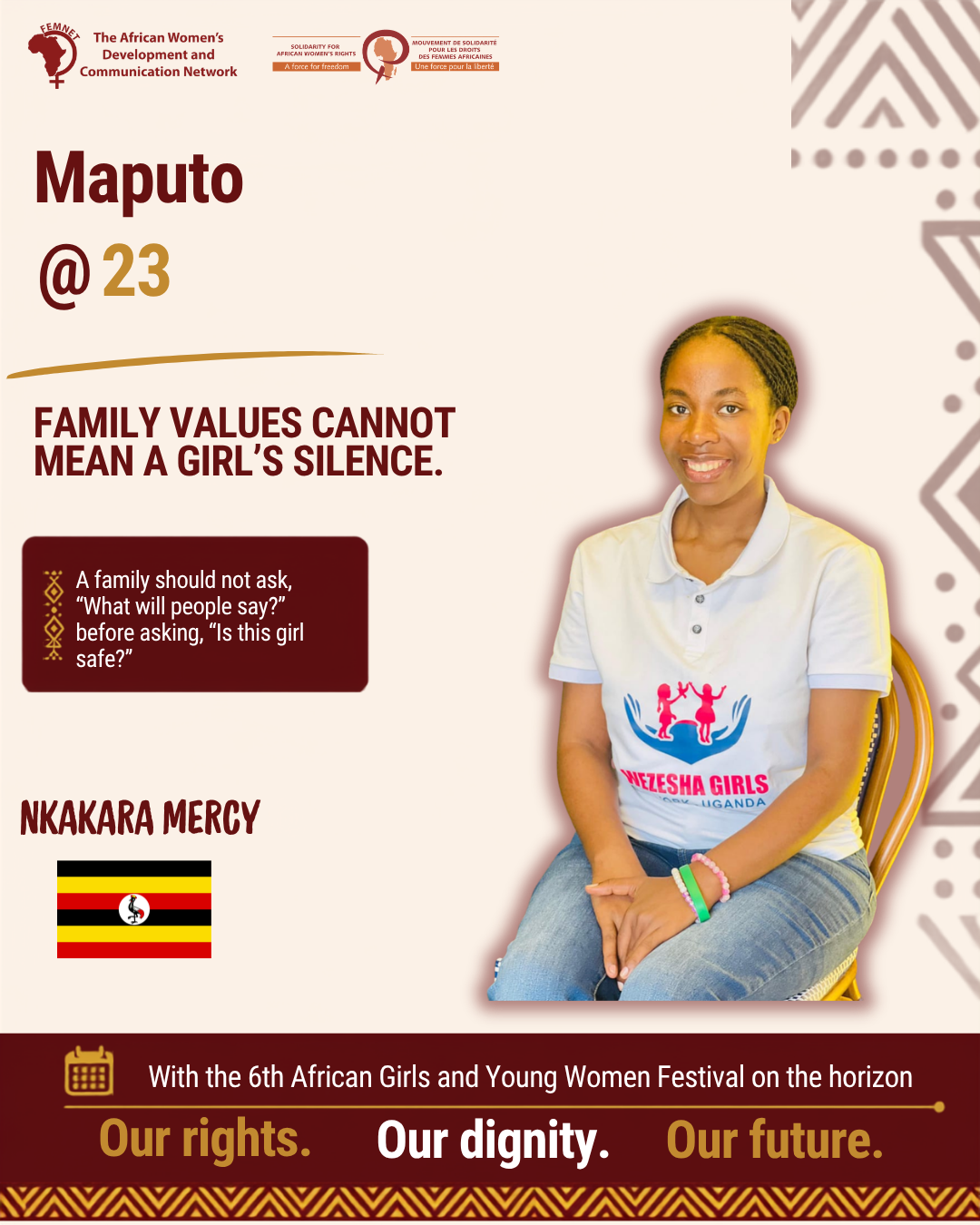
Family Values Cannot Mean a Girl’s Silence
A family should be a place where a child feels safe. It should be a place where a girl can ask questions, speak about what hurts her, dream about her future and grow without fear. But what happens when the words “family values” are used to silence her? What happens when culture is used to defend harm instead of stopping it? What happens when a girl is told to remain quiet because “that is how things are done”? These are important questions as we mark 23 years of the Maputo Protocol.
I understand that culture is important because it gives people a sense of belonging. It carries stories, language, music, knowledge and traditions from one generation to another. But culture is made by people, and people can change practices that cause harm. A tradition should never be used as an excuse to hurt a girl. A girl should not be forced into marriage because someone says it is part of culture. She should not be denied education because people believe a girl’s place is only in the home. She should not be told to keep quiet when she is being harmed because speaking up will “bring shame” to the family. She has the right to be heard. A family should not ask, “What will people say?” before asking, “Is this girl safe?”
Who gets to define family, culture and morality? This is a question we must ask honestly. Who decides what “family values” mean? Who decides which traditions are protected? Who decides what is moral? And when these decisions are made, where do girls’ rights sit? Too often, girls are left out of these conversations. Adults speak about girls. Leaders speak about girls. Communities make rules for girls. But girls themselves are rarely invited to speak. Let me remind you that a conversation about girls’ lives cannot be complete if girls are not allowed to speak.
The answer cannot be that culture belongs to adults while girls must simply obey. Girls are part of families. Girls are part of communities. Girls are part of culture. Their voices are also part of the future. Protection must be stronger than silence. Many harmful practices are defended using words like tradition, morality, family honour or protection. For example, child marriage has sometimes been presented as a way to protect girls. But evidence shows that child marriage can interrupt education, limit opportunities and expose girls to serious risks.
Non-discrimination must begin at home. A girl should not have fewer rights simply because she is a girl. The principle of non-discrimination is simple: every child matters. Every girl matters. Culture is not a museum. It is alive. It grows. It changes. Every generation has the responsibility to ask: What should we carry forward? What should we improve? What should we leave behind because it causes harm? We can keep traditions that teach kindness, community and respect. We can keep values that encourage children to care for one another. We can keep the wisdom of elders while also listening to the voices of young people. But we must be willing to change practices that hurt girls. Sometimes, changing a harmful practice is one of the greatest ways to protect the future.
Twenty-three years after the Maputo Protocol, the work is not finished. The Maputo Protocol gave Africa a strong promise: women and girls have rights. Those rights cannot depend on whether a community thinks a girl is quiet enough, obedient enough or “respectable” enough, because rights are not rewards for good behaviour. Rights belong to every girl. The work of protecting girls does not stop at signing laws and protocols. It must continue in homes, schools, places of worship, communities, courts, parliaments and in the conversations where people define family, culture and morality.
As we mark Maputo@23, we must remember that family values must never mean a girl’s silence. A family that protects girls does not silence them. A culture that values children does not harm them. A moral society does not ask girls to suffer quietly to protect the reputation of adults. And a strong Africa is not one where girls are told to disappear from difficult conversations. A strong Africa is one where girls are safe enough to speak, free enough to dream and protected enough to grow. If family values are truly about love, then girls’ rights must be at the centre of them.
Protect the girl. Listen to the girl. Believe the girl. Let the girl grow. That is not the end of family values; it is what family values should mean.
Compiled by Ainomugisha Mercy