
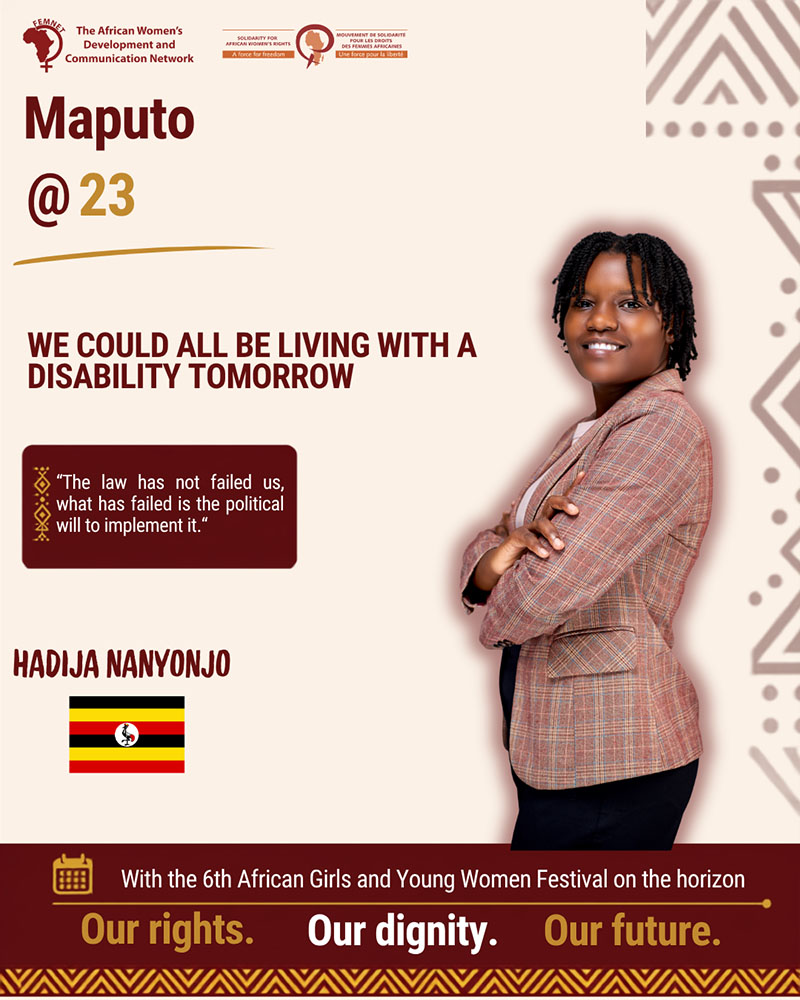
We Could All Be Living with a Disability Tomorrow
Have you ever stopped to imagine what your life would look like if you acquired a disability today, tomorrow, or in the blink of an eye? Probably not. It is one of those realities we rarely imagine until we are confronted with it. The truth is both humbling and urgent: for many of us, disability is not a distant possibility; it is just an accident or an illness away.
Now, consider this: We often speak passionately about the struggles of being a woman, unequal pay, unequal representation, unequal opportunities, and the fight for equality is real. But do we ever stop and ask, “what happens when you add disability into that equation?” The complexity deepens; the barriers multiply; the invisibility intensifies. To be a girl or woman living with a disability is to navigate a world that was not designed with you in mind, creating everyday hurdles. It is a life many of us cannot fully fathom, and perhaps that is exactly the problem.
“Inclusion refers to the practice of ensuring that individuals from diverse backgrounds and abilities are actively integrated and valued within various social contexts” – UNESCO. Inclusion is not charity or a favor but rather a fundamental right, and one that the Maputo Protocol enshrined with clarity and conviction 23 years ago.
This year, as we mark 23 years of the Maputo Protocol, a landmark continental framework intended to address several questions, we must then ask ourselves: Why does Article 23 form part of this document yet remain one of the least implemented provisions on paper? Why are girls and women living with disabilities still treated as an afterthought in families, communities, policies, programs, and public spaces when they should be at the very heart of the design? The Maputo Protocol has served as an essential foundation for safeguarding the rights of girls and women living with disabilities, mandating legal protections, access to employment, professional and vocational training, and freedom from violence. States have so far done a commendable job. But let us be honest with ourselves: it is just a starting point. Disability advocates across Africa had long recognized that a fragmented, gender-specific approach could not fully address the systemic exclusion faced by all persons with disabilities. This realization gave birth to the African Disability Protocol (ADP), a more comprehensive framework that demands structural accountability. Two protocols, two promises, and yet, if close attention is not paid, we risk leaving both on paper. Progress can only be realised when implementation is intentional and when people living with disabilities are included in spaces of power.
The idea, as can be deduced from these instruments, is commendable; however, if these instruments functioned as intended, we would not still be witnessing the staggering rates of sexual violence and economic marginalization that disproportionately target girls and women living with disabilities. Young women living with disabilities are turned away from job interviews consciously or subconsciously; work and interview spaces are not designed to accommodate persons living with disabilities. Girls and women with intellectual disabilities are raped with impunity, and their perpetrators are rarely held accountable. The law has not failed us, what has failed is the political will to implement it.
So today, as we mark 23 years of the Maputo Protocol, let us not merely celebrate its life; let us seek accountability in areas that require improvement and urgent action. There are still weak state reporting and enforcement mechanisms creating a gap between policy intentions and lived realities. True progress demands that we move from celebrating what is written on paper to demanding what is delivered on the ground.
Today, as we honor how far we have come, we recommit to how far we still must go because the full realization of Article 23 and indeed the ADP, will only be achieved when every girl and woman living with a disability across this continent can walk into any room and know without question that it was built with her in mind, not as an afterthought but a rightful heir to the Africa we are all still striving to build.