
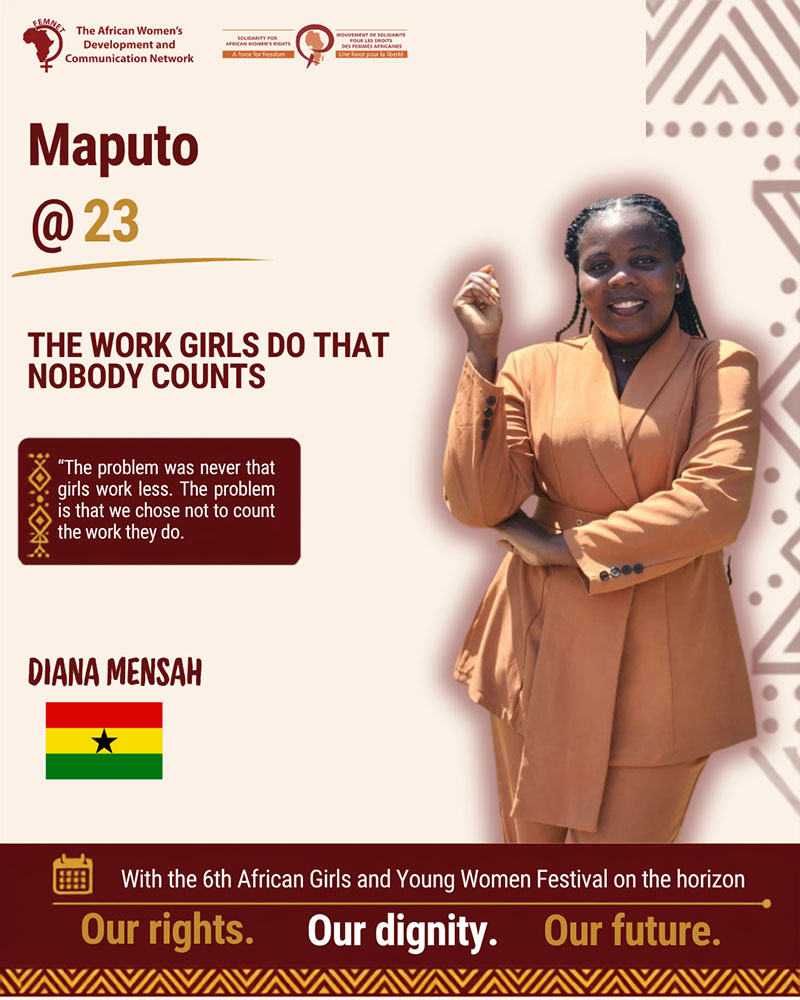
The Work Girls Do That Nobody Counts
Maputo @23 Campaign — Topic 11 | Article 13: Economic and Social Welfare Rights
Before the sun is fully up, she is already awake. She fetches water from the borehole, sweeps the compound, prepares breakfast, and gets her younger siblings ready for school. By the time she sits down for her own breakfast, if there is time for one, she has already done more work than most adults do in a day. Then she goes to school, or she doesn’t, because today her mother needs her at the market stall instead. Nobody calls this a job. Nobody writes it down anywhere. But it is work, and she is doing it.
Across Ghana, girls carry an enormous share of labor that never appears in any national record. This includes unpaid domestic work like cooking, cleaning, fetching water and firewood, and caring for younger siblings or sick relatives. It also includes informal economic work like helping in a family shop, trading in the market, or hawking goods on the street, often without pay, a contract, or any legal protection. According to Ghana Statistical Service data, girls are significantly more likely than boys to spend over 21 hours a week on unpaid household chores. Most working children in Ghana are found in services and domestic work, doing tasks as basic as fetching water and carrying loads. This labor keeps households running. It keeps families fed and children cared for. And yet it is treated as an obligation, not as work worth counting.
This invisibility is not an accident; it is built into how we measure “labor” in the first place. Official child labor statistics often focus on paid or formal work, where boys are more visible. But when researchers include unpaid household chores of 21 hours or more a week in the count, the picture flips entirely: girls become the larger share of child laborers, not boys. In other words, the moment we count all the work girls actually do, the story changes completely. The problem was never that girls work less. The problem is that we chose not to count the work they do.
Nowhere is this more visible, and more dangerous, than with the kayayei, girls and young women who travel from Ghana’s rural northern regions to cities like Accra and Kumasi to work as head porters, carrying heavy loads for market traders and shoppers. Many are still teenagers. They sleep in unsafe conditions, earn unpredictable and often exploitative wages, and are especially vulnerable to abuse. Their labor is real, physical, and exhausting, yet because it exists outside formal employment structures, it receives almost no legal protection. The kayayei are not an exception; they are what happens when uncounted work is left unprotected for long enough.
The Maputo Protocol was written to prevent exactly this kind of erasure. Article 13 recognizes women’s right to economic and social welfare, including protection from exploitative labor and recognition of their economic contributions. But recognition on paper means nothing if girls’ everyday work, at home, in the market, on the street, remains invisible to the systems meant to protect them. The promise of Article 13 cannot be fulfilled while girls’ labor is treated as background noise instead of a measurable, valuable contribution to families, communities, and the economy.
Change starts with counting. National labor and education statistics must include unpaid household work and informal economic activity done by girls, not just formal paid employment. Schools need policies that recognize when a girl’s home responsibilities are affecting her education, instead of simply marking her as truant. Communities need to talk openly about the disproportionate care and domestic burden placed on girls compared to boys, and question why it is treated as natural rather than as something that limits girls’ opportunities. Governments, NGOs, and local leaders need to extend labor protections to informal and domestic work, especially for girls like the kayayei who are doing dangerous work with no safety net.
Girls in Ghana are already carrying the weight of their households, their communities, and often their families’ survival. What they are not carrying is recognition. Until the work girls do is counted, it cannot be protected, and until it is protected, girls will keep paying the price for labor nobody agreed to see.