
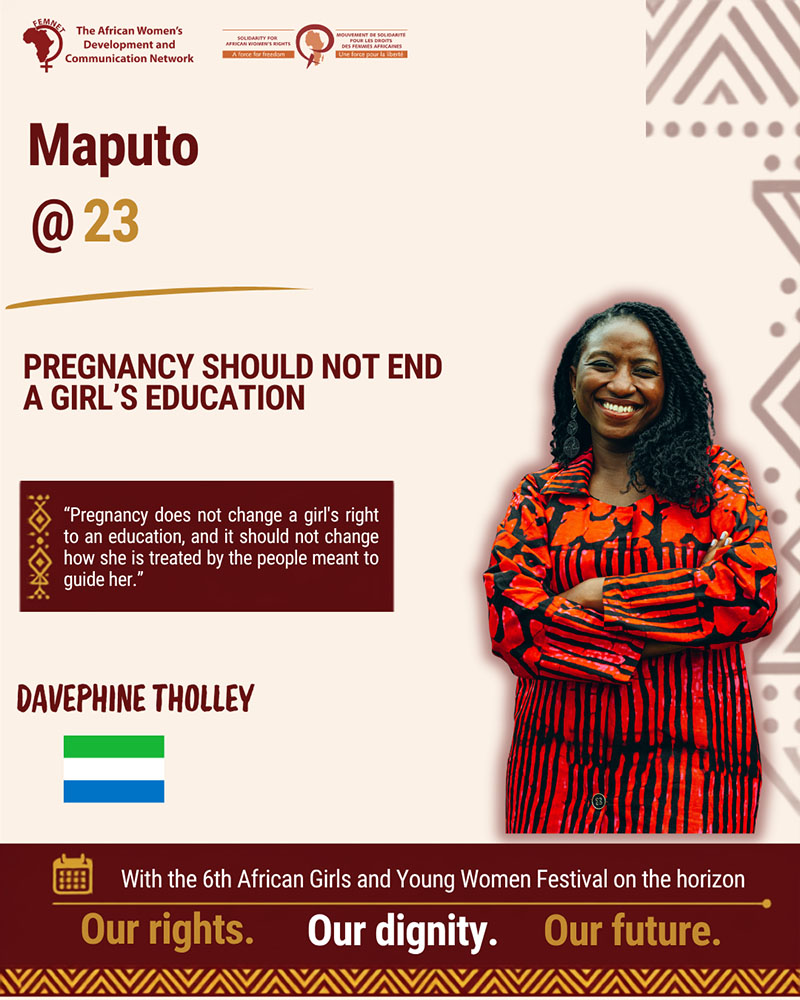
Pregnancy Should Not End a Girl’s Education.
“Aunty, do not be angry with me. I want to tell you something. I am pregnant.”
A young girl once told her aunt this. The aunt was shocked and a little disappointed. But let’s walk a mile in the girl’s shoes, shall we? When life takes an unexpected turn and you find out you are pregnant, should this end your education?
I have watched this happen to people close to me. For some, it was the end of school. For others, it was only a pause. They went back and finished their studies, and today they are good at what they do, which is proof that one moment does not have to dictate a whole life.
But here is the question that stays with me: why does the same situation end one girl’s education and not another’s? It is rarely about ability. It is almost always about support or the lack of it. Although sometimes, the girl chooses not to continue her education. What matters is that the choice is really hers to make, not one forced on her by shame or a closed door.
For those who continued their education, of course, there were people who tried to shame them or gossip. There is stigma. I do not condone the action. But I do not think they should be shamed and stigmatised. Corrected and guided, yes, but never shamed. Shame is definitely not of God.
What I also observed is that the family has a great role to play in support, guidance and correction. The girl also has the responsibility to be focused on her education and goals.
This is not just my opinion. It is a right that African governments have already promised to protect. The Maputo Protocol, the African Union’s treaty on the rights of women, formally called the Protocol to the African Charter on Human and Peoples’ Rights on the Rights of Women in Africa, is clear on this in Article 12. It commits countries to eliminate discrimination against women in education and, specifically, to promote the enrolment and retention of girls in schools and the organisation of programmes for women who leave school prematurely. The same article also obliges governments to protect girls from abuse and sexual harassment in schools and to provide counselling and support to those who experience it.
So a pregnant girl does not lose her right to learn. As of 2025, forty-six (46) out of the fifty-five (55) African Union member states, Sierra Leone included, have ratified the Protocol. It is a legal promise.
However, why does the gap between the promise and reality remain so wide?
Sierra Leone’s history shows how wide the gap can be. According to Human Rights Watch (2023), until 2020, Sierra Leone’s government banned “visibly pregnant girls” from attending school entirely. That ban was introduced in 2015, after schools reopened after the Ebola crisis, which had caused a spike in teen pregnancies. It only ended after West Africa’s regional court ruled it discriminatory in 2019, and President Julius Maada Bio reversed it in 2020.
Acknowledging a problem is not the same as solving it. Many girls, especially those in rural areas, are still at risk of being pushed out in practice, if not on paper. The stigma has not disappeared either. Even after the ban was lifted, some parents said they did not want their daughters in a classroom with a pregnant girl. That is the gap. The law has changed faster than people’s mindsets have.
Judgement is easy. It costs nothing to whisper, stare, or pass judgement on a girl’s future. What costs something and actually changes a life is a school that welcomes her back, a family that keeps guiding and believing in her and a community that treats having a baby as a reason to plan, not a reason to give up.
Pregnancy is a serious, life-changing event. It is. It changes the body, routines, responsibilities, and sometimes plans. Pregnancy does not change a girl’s right to an education, and it should not change how she is treated by the people meant to guide her.
So here is what needs to change, and who needs to act:
Schools need clear, publicly known re-entry policies, so no girl has to guess whether she is welcome back. Communities and families need to stop treating pregnancy as the end of a girl’s story and start asking what support she needs to keep writing it. Governments need to move Article 12 from paper to practice by enforcing policies that protect a girl’s right to education and training.
“Aunty, are you angry about what I just told you? I do not know how to tell my mum.” “My dear, come sit. I am disappointed. But I am here to help guide and support you. You have to promise me that you are really sorry about this and also determined to do better.”
Human Rights Watch (2023). Education for all girls in Sierra Leone. [online] Human Rights Watch. Available at: https://www. hrw. org/news/2023/05/08/education-all-girls-sierra-leone [Accessed 26 July 2026].
Mumbi Mugo (2026). 23 Years after the Maputo Protocol: From promise to practice for women and girls in Africa. [online] Equality Now. Available at: https://equalitynow. org/news/news-and-insights/23-years-after-the-maputo-protocol-from-promise-to-practice-for-women-and-girls-in-africa/ [Accessed 26 July 2026].