
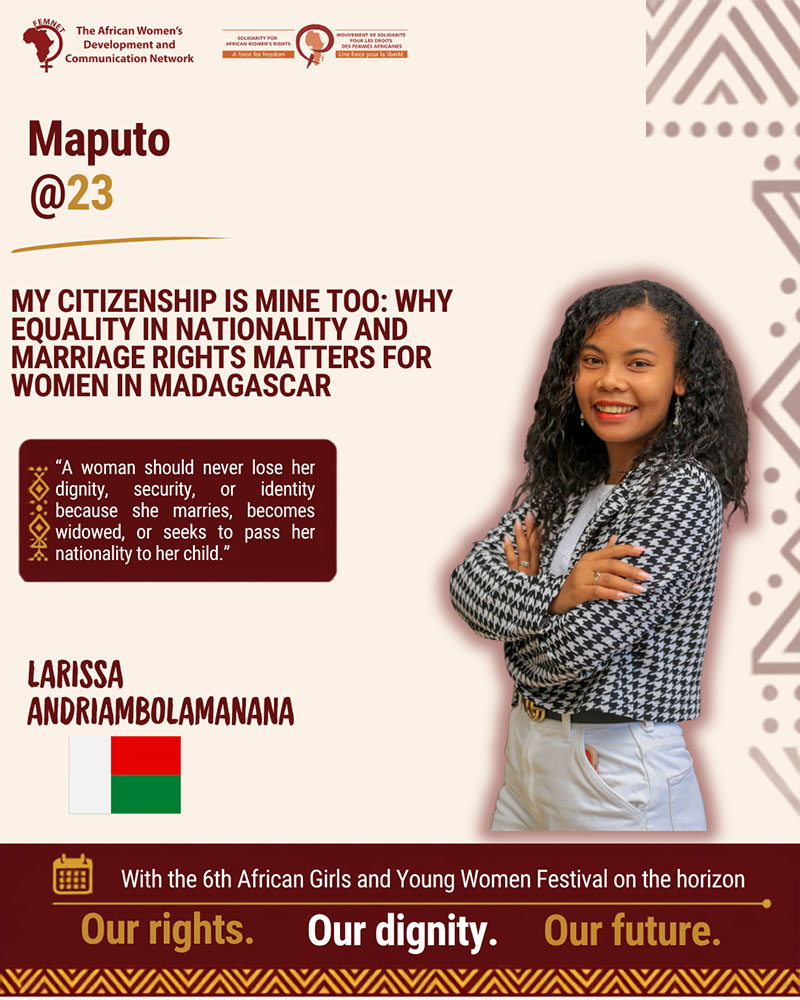
My Citizenship Is Mine Too: Why Equality in Nationality and Marriage Rights Matters for Women in Madagascar
Twenty-three years after the adoption of the Maputo Protocol, Africa has made significant progress in recognizing the rights of women and girls. However, for many women in Madagascar, equality remains incomplete. As a young Malagasy woman, I believe that citizenship is more than a legal status. It is about identity, dignity, belonging, and the ability to fully participate in society. The campaign “My Citizenship Is Mine Too” reminds us that every woman deserves equal rights in marriage, nationality, inheritance, and property.
The Protocol to the African Charter on Human and Peoples’ Rights on the Rights of Women in Africa (Maputo Protocol), adopted in 2003, is one of the most progressive legal instruments protecting the rights of women on the African continent (African Union, 2003). Article 6 promotes equality in marriage by ensuring that women have equal rights and responsibilities before, during, and after marriage. It also recognizes women’s rights concerning nationality and calls on States to eliminate discrimination in laws affecting women’s legal status (African Union, 2003).
For many years, Madagascar’s nationality law discriminated against women. Malagasy fathers could automatically pass their nationality to their children, while mothers did not enjoy the same right under equal conditions. This inequality exposed some children to the risk of statelessness and denied many women equal recognition as citizens within their own families (UNHCR, 2017). In 2017, Madagascar amended its nationality law through Law No. 2016-038, allowing women and men to transmit Malagasy nationality equally to their children. This reform represented an important milestone for gender equality and the protection of children’s rights (UNHCR, 2017; Equal Rights Trust, 2019).
Although this legal reform deserves celebration, equality is still not fully achieved. Malagasy women continue to face legal, social, and cultural barriers that limit their rights within marriage and family life. Citizenship is closely linked to other rights, including access to education, employment, healthcare, land ownership, inheritance, and legal protection. When women are treated unequally under the law, these inequalities affect entire families and future generations (African Commission on Human and Peoples’ Rights, 2023).
One issue that continues to concern many women in Madagascar is property and inheritance. While the Constitution guarantees equality between women and men, customary practices often influence inheritance decisions, particularly in rural communities (OECD Development Centre, 2023). In practice, widows may experience discrimination when claiming property after the death of their husbands, especially where customary norms prevail over statutory law. In some communities, extended family members may claim ownership of property, leaving widows economically vulnerable despite years of contributing to the household (U. S. Department of State, 2023).
This reality raises an important question: Can women truly enjoy full citizenship if they are not equally protected within marriage and after the loss of their spouse?
For girls and young women in Madagascar, these inequalities send a harmful message that their legal identity and economic security may depend on someone else rather than on their own rights. Such discrimination discourages women’s economic empowerment and reinforces gender inequality. According to the World Bank (2024), legal equality contributes directly to women’s participation in the economy, poverty reduction, and sustainable development.
The Maputo Protocol reminds us that women’s rights are human rights. Equality should not end with the right to vote or attend school. It should extend to every aspect of life, including marriage, nationality, inheritance, and ownership of property. A woman should never lose her dignity, security, or identity because she marries, becomes widowed, or seeks to pass her nationality to her child.
As a young Malagasy woman, I believe that legal reform alone is not enough. Communities need greater awareness of women’s rights. Traditional practices that discriminate against women should be challenged through education and dialogue. Government institutions should continue reviewing laws that create unequal treatment, while civil society organizations should empower women to understand and claim their legal rights.
Twenty-three years after the adoption of the Maputo Protocol, Madagascar has made encouraging progress, but there is still work to do. Equal citizenship means equal opportunities, equal protection, and equal dignity. Every Malagasy woman deserves to enjoy her rights without discrimination.
My citizenship is mine too. My rights are mine too. My future is mine too.
References (APA 7th Edition)
African Commission on Human and Peoples’ Rights. (2023). The Maputo Protocol at 20: Advancing the rights of women in Africa. https://www. achpr. org
African Union. (2003). Protocol to the African Charter on Human and Peoples’ Rights on the Rights of Women in Africa (Maputo Protocol). https://au. int/en/treaties/protocol-african-charter-human-and-peoples-rights-rights-women-afr ica
Equal Rights Trust. (2019). Equality and non-discrimination in Madagascar: Submission to the Human Rights Committee. https://www. equalrightstrust. org
OECD Development Centre. (2023). SIGI 2023 Global Report: Gender equality in Madagascar. https://www. genderindex. org
United Nations High Commissioner for Refugees. (2017). Nationality reform a major step towards ending statelessness in Madagascar. https://www. unhcr. org/news/stories/nationality-reform-major-step-towards-ending-statelessne ss-madagascar
- S. Department of State. (2023). 2023 Country Reports on Human Rights Practices: Madagascar. https://www. state. gov/reports/2023-country-reports-on-human-rights-practices/madagascar/
World Bank. (2024). Women, Business and the Law 2024. https://wbl. worldbank. org
World Bank. (2024). Madagascar Overview. https://www. worldbank. org/en/country/madagascar
United Nations Women. (2023). Progress on the Sustainable Development Goals: The gender snapshot 2023. https://www. unwomen. org
United Nations Children’s Fund. (2023). The State of the World’s Children 2023. https://www. unicef. org