
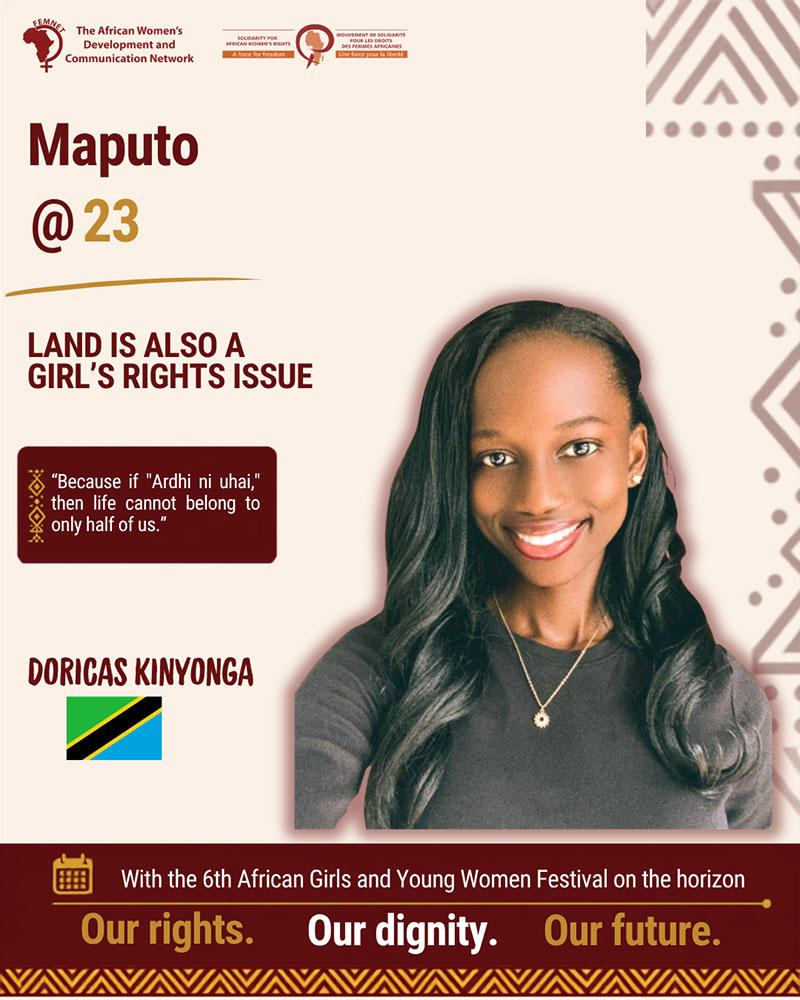
Land is also a Girl’s Rights Issue
By Doricas Kinyonga
I have always found it strange that the earth never asks who is planting the seed.
It never pauses to ask,
“Are these hands a boy’s or a girl’s?”
It simply opens itself.
It receives.
It grows.
Maybe that is why I struggle to understand why people do.
Growing up in Tanzania, I believed land could remember.
It remembers the tiny footprints of little girls chasing butterflies between cassava fields. It remembers grandmothers humming as they weed maize beneath the afternoon sun. It remembers every seed buried with hope, every harvest gathered with tired hands, and every prayer whispered to the skies when the rains delayed.
To us, land has never been just soil.
It is memory. It is identity. It is belonging.
It is the smell of rain kissing dry red earth after months of waiting. It is banana trees planted by grandparents whose stories still live in their shade. It is the cassava fields where children laugh until the sun disappears behind the hills. It is where families gather after harvest to thank God for another season.
In Tanzania, we say, “Ardhi ni uhai.”
Land is life.
As a child, I never questioned those words. I only knew that land fed families before it built houses. It paid school fees. It carried the graves of our ancestors and the dreams of generations yet to come.
Land carried our stories.
Then I grew older.
And I noticed something I had somehow missed.
The women were always among the first to arrive in the fields and the last to leave them.
Yet they were not always the ones who owned the land.
I think about girls I have met in places like Geita, Morogoro, and villages not so different from many others across Tanzania. Their names are different, but their stories often sound painfully familiar.
One wakes before sunrise, wraps a khanga around her waist, and walks to the shamba with her mother.
Before the village fully wakes, she has already fetched water, weeded vegetables, and chased birds away from the maize. She knows where the soil is richest. She knows which mango tree flowers first after the rains. She knows which path becomes muddy before anyone else notices.
She knows the land the way one knows a friend.
But knowing it has never meant owning it.
Then one day, her father dies.
The family gathers beneath the same mango tree she climbed as a little girl.
They speak about acres.
About boundaries.
About inheritance.
Then someone quietly says,
“Msichana ataolewa. Ardhi ibaki kwa watoto wa kiume.”
“The girl will get married. The land should remain with the boys.”
And just like that, years of planting, carrying water, protecting crops, and loving that land disappear behind a sentence she never had the chance to challenge.
This may not be every girl’s story.
But it is a story that too many girls understand.
Through my work with young climate leaders, I have come to realise another painful contradiction. We encourage girls to plant trees, restore ecosystems, protect forests, and become champions for climate action. We celebrate them as guardians of the land.
Yet we rarely stop to ask whether they will one day have the right to own the very land they are protecting.
That question has stayed with me.
Because land is never only about ownership.
It is about belonging.
It is about dignity.
It is about having the freedom to dream without asking someone else’s permission.
An African proverb reminds us:
“Until the lion learns to write, every story will glorify the hunter.”
Perhaps the same is true for girls and land.
Until a girl owns the land, every story about the land will remain incomplete.
Twenty-three years ago, African leaders adopted the Protocol to the African Charter on Human and
Peoples’ Rights on the Rights of Women in Africa, widely known as the Maputo Protocol. Through it, they affirmed that women have the right to access and control productive resources, including land, and to inherit property equitably. It was a bold promise that recognised dignity, equality, and justice as foundations for Africa’s future.
Yet for many girls today, that promise still feels as distant as the horizon beyond the shamba.
As climate change reshapes our continent, this conversation becomes even more urgent.
When drought dries our rivers, who walks farther searching for water?
When floods destroy harvests, who stays behind trying to save what is left?
When crops fail, who quietly eats less so younger siblings can eat?
Too often, the answer is women and girls.
Yet they remain among those least likely to own the very land they sustain.
How can we ask girls to become champions of climate resilience while denying them secure rights to the soil beneath their feet?
That contradiction should trouble all of us.
This is why I believe land is also a girl’s rights issue.
Not because girls are asking for special treatment.
But because equality should not end where the farm begins.
Changing this reality will take more than laws. It will take conversations around family tables where inheritance is discussed. It will take community leaders willing to question traditions that no longer serve justice. It will take parents who look at their daughters and see not temporary visitors in the family, but equal heirs to its future.
As Wangari Maathai wisely said,
“The more you know your rights, the more you are able to protect them.”
Twenty-three years after the Maputo Protocol was adopted, our responsibility is not only to celebrate its existence but to make its promises real. A right written on paper should also be visible in our homes, our communities, and our fields.
I hope every girl in Tanzania and across Africa knows that the right to land is not something she should apologize for wanting.
It is something she has always deserved.
Because if “Ardhi ni uhai,” then life cannot belong to only half of us.
I dream of an Africa where no girl grows up believing she is only good enough to work the land but not worthy enough to inherit it.
An Africa where daughters no longer stand at the edge of family meetings waiting for others to decide their future.
An Africa where every seed planted by a girl grows into more than a harvest.
It grows into confidence.
Into opportunity.
Into leadership.
Into freedom.
And perhaps then, when another little girl runs barefoot across her family’s shamba after the first rains, she will not wonder whether she belongs there.
She will already know.
Because the land remembers every hand that cared for it.
It is time our societies did too.