
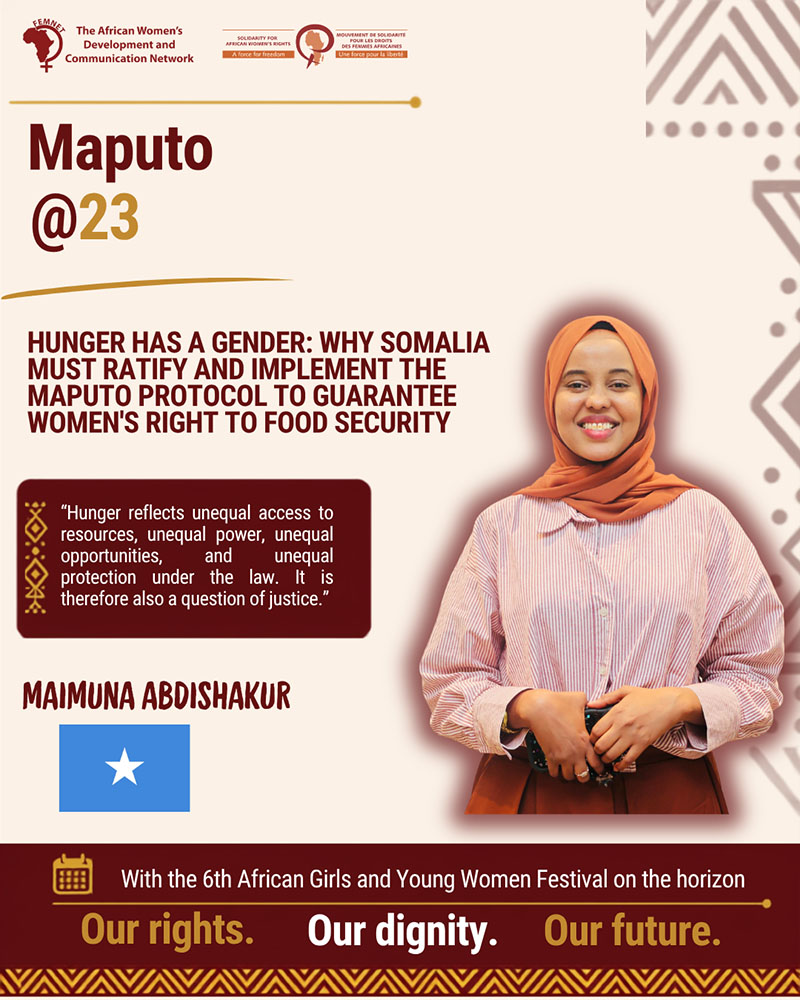
Hunger Has a Gender: Why Somalia Must Ratify and Implement the Maputo Protocol to Guarantee Women’s Right to Food Security, Article 15 of the Maputo Protocol
For more than three decades, Somali women and girls have carried the heaviest burden of conflict, displacement, climate shocks, and economic instability. While the country has made important progress toward peacebuilding and state reconstruction, food insecurity remains one of the greatest threats to the dignity, health, and future of millions of women. Access to adequate and nutritious food is not merely a humanitarian concern—it is a fundamental human right.
The Protocol to the African Charter on Human and Peoples’ Rights on the Rights of Women in Africa (Maputo Protocol) is Africa’s most comprehensive legal instrument protecting women’s rights. Among its many guarantees, Article 15 explicitly recognizes every woman’s right to food security, making it the first regional human rights treaty in Africa to specifically protect this right. Article 15 requires States Parties to ensure that women have access to nutritious and adequate food by guaranteeing clean drinking water, domestic fuel, land, the means of producing food, and effective food supply and storage systems. Unlike many international instruments that imply the right to food through broader economic and social rights, the Maputo Protocol explicitly recognizes food security as a legal entitlement for women. The accompanying legal commentary emphasizes that African women are central to food production and household food security, yet they remain disproportionately affected by hunger, malnutrition, poverty, and unequal access to productive resources.
In Somalia, hunger is not experienced equally. It has a gender.
Women are often the first to sacrifice their own meals so that their children can eat. They are responsible for finding water, preparing food, caring for children, supporting elderly family members, and sustaining households despite having the least access to land, income, credit, and productive resources. During periods of drought, conflict, displacement, or economic crisis, these inequalities deepen, leaving women and girls at the center of Somalia’s food insecurity crisis.
Decades of armed conflict, recurring droughts, devastating floods, displacement, inflation, and fragile public institutions have severely weakened food systems across Somalia. Women, particularly those living in rural communities, internally displaced persons (IDP) settlements, and female-headed households, continue to bear the greatest burden. Limited access to clean water, safe livelihoods, healthcare, and nutritious food has created a cycle of poverty and malnutrition that affects not only women themselves but entire generations of Somali children.
Although Somalia has made important progress by establishing national social protection programmes and expanding assistance to vulnerable households, current interventions remain insufficient to meet the magnitude of the country’s humanitarian and development challenges. Millions of Somalis continue to experience food insecurity, while women remain disproportionately represented among those facing chronic hunger and malnutrition.
Article 15 of the Maputo Protocol offers Somalia a practical and legally binding framework for addressing these inequalities. The Protocol requires States Parties not only to ensure women’s access to adequate and nutritious food but also to provide access to clean drinking water, domestic fuel, productive land, and systems that guarantee sustainable food security.
Importantly, food security extends far beyond emergency food assistance. According to the legal interpretation of Article 15, food security exists when women have continuous physical, social, and economic access to sufficient, safe, nutritious, and culturally appropriate food. It also requires food availability, accessibility, proper utilization, stability, sustainability, and the ability of women to make decisions about their own food systems.
For Somali women, these rights remain largely unrealized.
Many women cultivate land they do not legally own. Others walk long distances every day to collect water and firewood, reducing opportunities for education, employment, and income generation. Female-headed households often have fewer livelihood opportunities and are more vulnerable to economic shocks. Displaced women face additional barriers, including insecure shelter, limited humanitarian assistance, increased exposure to gender-based violence, and inadequate nutrition for themselves and their children.
These realities demonstrate why hunger cannot simply be understood as the absence of food. Hunger reflects unequal access to resources, unequal power, unequal opportunities, and unequal protection under the law. It is therefore also a question of justice.
Ratifying the Maputo Protocol would represent a significant commitment by Somalia to recognize women’s rights including food security as a legally enforceable human right. However, ratification alone is not enough. Genuine implementation requires translating Articles into national legislation, public policies, budget allocations, institutional reforms, and effective monitoring mechanisms.
Implementation should include strengthening social protection programmes, expanding nutrition services, investing in climate-resilient agriculture, increasing women’s access to land ownership and agricultural finance, improving rural water infrastructure, supporting women farmers, protecting female-headed households, and ensuring women’s equal participation in food security governance.
Protecting women’s right to food security also strengthens every other development objective. Well-nourished mothers are more likely to give birth to healthy children. Children who receive adequate nutrition are more likely to survive, attend school, and reach their full potential. Households led by economically empowered women become more resilient to climate shocks and conflict. Communities become healthier, more productive, and better equipped to recover from crises
Somalia stands at an important moment in its state-building journey. As the country continues to strengthen its legal and policy frameworks, the Maputo Protocol provides an African solution rooted in African values and African human rights standards. Ratifying and implementing Maputo protocol including Article 15 would demonstrate Somalia’s commitment to protecting the dignity, equality, and wellbeing of its women and girls.
Conclusion
Because hunger is not gender neutral
It falls disproportionately on women who feed their families before feeding themselves; on mothers who endure hunger so their children can survive; on girls whose education is interrupted by poverty, displacement, or early marriage; and on women whose unpaid labour keeps households functioning despite immense hardship.
Recognizing this reality is the first step
Ratifying and implementing the Maputo Protocol is the next. For Somalia, ensuring every woman has access to nutritious food, clean water, productive resources, and effective social protection is not only a legal obligation—it is a foundation for sustainable peace, inclusive development, and a future where every woman and girl can live with dignity, free from hunger.
By Maimuna Abdishakur Mohamed Somalia Maimunshakur@gmail. com