
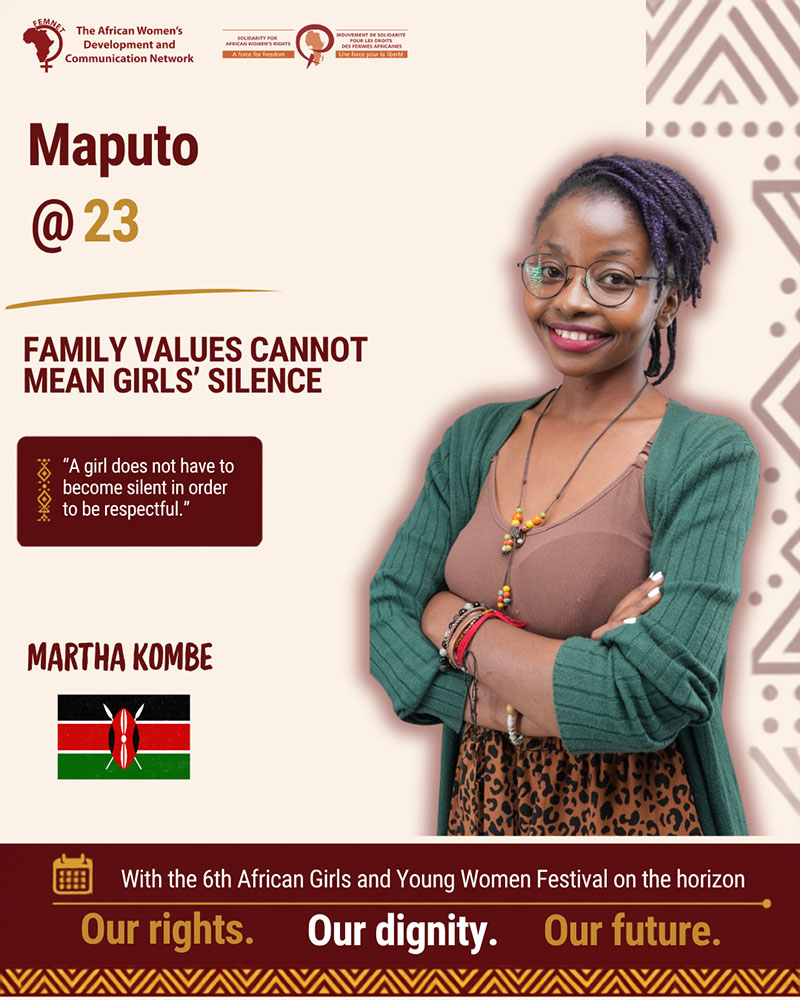
Family Values Cannot Mean Girls’ Silence
Reclaiming the Home as a Place Where Girls Are Heard
In many Kenyan homes, wisdom is imparted to children through stories that are shared by elders in families, clans and communities.
Another proverb from Kenya is that wisdom is shared through stories. A grandmother may tell her grandchild not to sit too close to the fire. An uncle would say that a homestead without discipline will fall apart like a granary that has been eaten by termites. A father would say that a tree that grows straight is a tree that has been guided from a young age.
The foundation of families, culture and community is very important; it is where we come from. But a house that cannot hear the voice of girls and women will never be a house that can protect them.
Family values in many Kenyan homes are used as a veil to keep girls silent and respectful at all costs. They are expected to hide their pain and lower their voices, all in the name of showing respect to their elders. Many are expected to carry shame that is not theirs to bear. Many communities believe that obedience is the ultimate responsibility of girls and young women, regardless of the cost to their health, education, well-being and future.
The Maputo Protocol still matters at 23 years. The Protocol was adopted in 2003 and entered into force in 2005. It is one of the strongest human rights instruments on the continent specifically focusing on the rights of women and girls. As a Kenyan, I am particularly interested in when we, as a country, ratified this Protocol: 2010. More than two decades later, are we living these rights in our daily lives, especially at home, in school, at health facilities, at places of worship, at the baraza of the chief, on WhatsApp groups of families and many others where decisions are made on behalf of girls and young women?
Furthermore, Article 17 of the Maputo Protocol provides for women’s right to live in a positive cultural environment, to participate actively in their communities, and to influence decisions regarding cultural policies. In our pursuit of promoting and protecting the rights of women and girls, this is one of the issues we must bring to the forefront: transforming negative cultural practices into positive ones that can serve as a shelter for our girls instead of a cage.
Yes there are laws that exist to protect the rights of children to be treated humanely and to be protected from all forms of harm. The challenge however is to ensure that these laws are adhered to and upheld by all. Some laws that are meant to prevent harm to children are sometimes packaged within negative cultural practices and thus when someone says they are upholding family values, one has to ask and confirm whether the values in question are those that would safeguard the child from any form of harm or whether the values would demand a child to grow up too fast in order to take care of a parent or parents.
In many cultures, matters concerning girls’ and women’s bodies are treated as moral issues to be policed by others, rather than as matters of rights, health and dignity. For instance when a girl is at the health facility or school talking to a health worker or teacher about using contraception she is labeled ‘spoiled’ and is told off. A schoolgirl who gets pregnant is said to have let down her parents and that she should be out looking for a job to support herself instead of being at school with the rest of her fellow students to continue her education and receive the care that she so rightly deserves. A girl who reports the fact that she has been abused is expected to maintain silence to protect the family name of her abuser. And lastly a young woman who posts something on the internet is reminded that girls are expected to behave in a manner that is more becoming for them and are scolded for being too loud, too modern and for exposing themselves in public.
When we silence the voices and needs of girls and women they are never safe. In Kenya, 15% of adolescent girls (15-19 years) have ever been pregnant (KDHS 2022). When a girl in school is pregnant she has grown up too fast, and is expected to take on the full responsibilities of the adult woman.
Family values should be felt in action when a family is going through its toughest times: when a girl is looking for information before it is too late and harm is done, when a child reports abuse for the first time and is believed, when a pregnant schoolgirl is cared for instead of sent away by her family and friends in shame, when boys are encouraged to take responsibility for themselves to get consent before doing anything to or with girls and boys, to be tender and to show affection to girls and boys.
Protecting girls and valuing families is not a choice between two opposing things. When it counts most, protecting the child is the only option.
Just like a cracked calabash is not blamed for the leakage of its contents because the contents did not fault; but rather the contents are merely released from the cracked calabash, and the blame is put on the calabash for failing to hold the water contained in it, likewise our families, schools, our places of worship and our communities are the calabashes that we fill with our children. These calabashes are then carried through life by the contents in them. The child in the calabash of a family, a school, a place of worship or a community is the contents of that calabash. When the calabash of a family cracks, a child from that family leaks out. That child can leak into shame. A child can also leak out of school. And in a lot of cases children who leak out of school will stop helping others who are in trouble, because the “good girl” never asks for help. So this is how the child in the cracked calabash of a family is protected from harm.
Culture can be a positive source of care and respect for girls, and a space where their voices carry weight.
A girl does not have to become silent in order to be respectful. She does not have to shrink in order to be accepted. And she should not have to suffer in silence in order to protect the family name.
The strongest family value is to protect the family members. Listening to the most vulnerable members and allowing them to be heard is protection.