
With Thought, Needle and Thread: The Beginning of a New African Feminist Economic Imagination
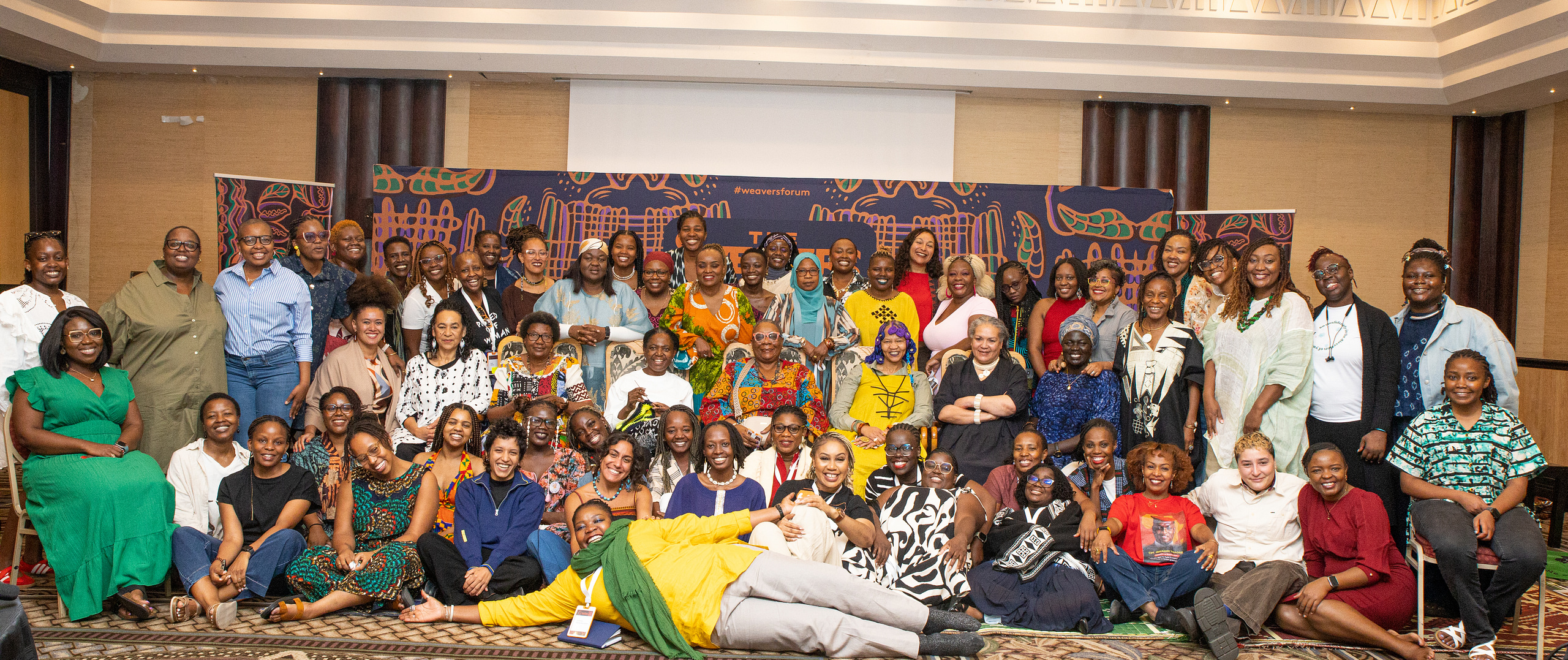
There are gatherings you attend, take notes, exchange contacts, take a few photographs, and return home. Then some gatherings feel like the beginning of something much bigger. The inaugural Weavers Forum, held from 5–8 August 2026 in Windhoek, Namibia, was undoubtedly the latter. It was the first of its kind—a new biennial gathering bringing together Pan-African feminist political economy thinkers, practitioners, economists, scholars, artists, movement builders and organisers to collectively interrogate the economies we have inherited and, more importantly, imagine the economies we want to build.
The Forum was never simply about talking economics. It was about pulling at the threads that hold our economies together, examining the knots and loose ends, tracing where they came from and asking whether we are ready to weave something different. And so, in Windhoek, the loom was set. The first thread was pulled, and the weaving began.
From the very beginning, it was clear that this would not be your conventional economics gathering. We opened not with graphs, figures or technical presentations, but with poetry. Namibian poet Frieda Mukufa grounded the space in Namibia’s histories, struggles and aspirations, reminding us that political economy is not an abstract discipline living somewhere inside policy documents. It is lived. It is felt. It is experienced in our homes, our communities, our workplaces and our movements.
Crystal Simeoni, Executive Director of NAWI, welcomed participants by reflecting on the vision behind creating a dedicated continental space for African feminist political economy. Memory Kachambwa, Executive Director of FEMNET, connected the gathering to the broader work of African feminist movement-building and the need for economic justice and decolonial approaches to political economy. Juliet Nangamba of Akina Mama wa Afrika, meanwhile, reminded us that the Forum was also a space to pause, build relationships, strengthen solidarity and replenish ourselves for the work ahead.
As Memory reflected, the Weavers Forum was envisioned as “more than a gathering; it is a space for collective learning, political reflection, intellectual renewal and restoration.” It was an opportunity for African feminists to deepen their thinking on economic justice and decolonial political economy while beginning to weave a new collective political and intellectual project for the continent.
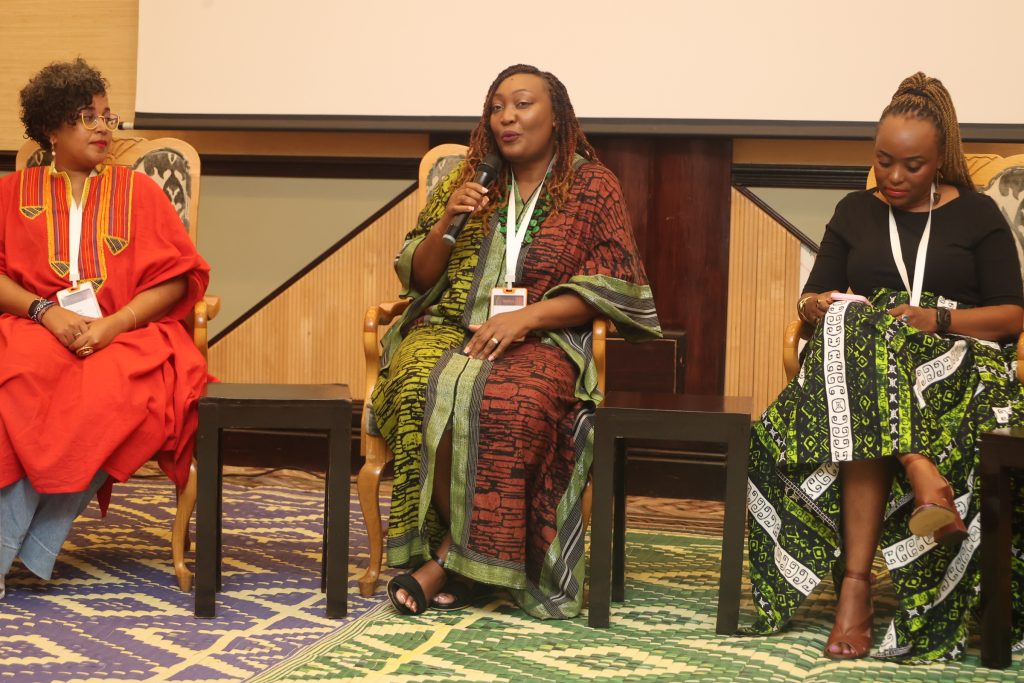
Weavers Forum co-conveners, from left: Crystal Simeoni (NAWI), Memory Kachambwa (FEMNET), and Juliet Nangamba (AMwA), during their opening remarks.
And then came the question: What happens when feminists take the economy apart and put it back together?
Well, first, we begin by questioning what we have been taught to call “the economy.”
For generations, economic conversations have often been dominated by GDP, markets, growth, inflation, debt, trade and fiscal policy. Important, yes. But what happens to the woman who wakes up before everyone else, prepares food, takes care of children, tends to an elderly parent, goes to work, returns home and starts another shift that nobody calls “work”? Who counts her labour? Who measures her contribution? Who decides what is valuable?
These were some of the questions running through the Weavers Forum. African feminist political economy starts from a simple but powerful recognition: women have never been outside the economy. They have always been producing, trading, caring, organising, farming, creating and sustaining communities. The problem is that much of this labour has been rendered invisible, undervalued or treated as an endless resource to be extracted.
The political grounding session, “From Macroeconomics to African Feminist Political Economy,” brought this tension sharply into focus. Through With Thought, Needle and Thread, an artistic offering by Philiswa exploring bodily labour, memory and domestic creation, the metaphor of the Forum came alive. The needle and thread became more than objects. They became a way of thinking—a way of asking which threads mainstream economics leaves hanging, whose labour is recognised and whose is overlooked, who controls the loom and who gets to benefit from the finished cloth.
Fatimah Kelleher challenged the limitations of GDP and other mainstream measures of economic success, particularly their failure to account for care and social reproduction. She connected trade liberalisation, structural adjustment, debt regimes and land acquisition to the everyday experiences of women, including women cross-border traders and displaced communities.
Her reflection captured the heart of the challenge: “If our measures of economic success continue to overlook care, social reproduction and the labour that sustains our communities, then they will never tell the full story of our economies. We have to interrogate the colonial and patriarchal foundations of the global economic system and ask who benefits, whose labour is valued, and whose lives bear the cost.”
Mumbi Kanyogo pushed the conversation further, questioning the idea that economic policies are neutral. Her reflections connected austerity, high interest rates and structural adjustment to the unpaid reproductive labour that women are expected to absorb. The conversation left us with a challenge that is difficult to ignore: Are we ready to move beyond critique and build power?
Not simply analyse the system. Not simply produce another report. Not simply sit on another panel. But organise. Build alternatives. Create cooperative systems. Strengthen mutual aid. Reimagine ownership. Build economies around collective wellbeing rather than endless accumulation.
And if economics is about how societies organise resources, then perhaps it is time we asked a much more basic question: What kind of life are our economies actually organising us for?
That question took us somewhere equally important: memory.
The Intergenerational Roundtable and Collective Harvest on African feminist memory, political economy and futures reminded us that movements, just like people, have histories. They have stories that must be remembered, lessons that must be carried forward and mistakes that must not be repeated.
Muthoni Wanyeki reflected on growing up in post-independence Kenya, where the optimism of independence existed alongside authoritarianism, inequality and poverty. She emphasised the importance of documenting movement histories, especially the stories of women and non-state actors whose contributions are too often missing from official accounts.
Her reflection offered another essential thread for the weave: “We cannot build the future without remembering the movements and struggles that brought us here. We need to document our histories, particularly the contributions of women and non-state actors, so that younger generations can understand the diverse political strategies and traditions that have shaped our struggles for liberation and democracy.”
Professor Amina Mama took participants through decades of African feminist, Pan-African, anti-imperialist and socialist organising while raising difficult questions about NGOisation, donor dependency and the professionalisation of movements. And this is where the conversation became beautifully uncomfortable.
Because remembering our history is not simply about celebrating those who came before us. It is also about asking what happened along the way. What did we gain? What did we lose? Which political demands became projects? Which movements became institutions? Which radical ideas were softened to fit funding frameworks? And what happens when the infrastructure that keeps a movement alive begins to shape what that movement is able to say?
These are not easy questions. But perhaps that is exactly why intergenerational spaces matter.
Younger feminists need the wisdom of those who came before them. Older generations need the questions and imagination of those coming behind them. The answer is not to romanticise either generation. It is to create spaces where both can sit at the same table, share the same history and argue about the future.
Different threads. One cloth.
The Forum also challenged us to reconsider what we mean when we talk about wealth. What if wealth is more than money? What if it includes knowledge, relationships, community, heritage, time and care?
Think about the grandmother who passes down knowledge of seeds and seasons. The farmer who feeds a community. The woman who starts a small enterprise and creates work for others. The neighbour who shows up when another family is struggling. The organiser who gives her time to keep a movement alive.
These are economic contributions too.
They may not always appear in national accounts, but they are part of what keeps society moving. They are part of the invisible infrastructure that holds communities together.
And perhaps that is one of the most powerful threads running through African feminist political economy: the insistence that what sustains life must count.
The Weavers Forum has begun pulling at these threads. It has created a space to question the economic systems we have inherited, recover the knowledge that has been pushed to the margins, listen across generations and, perhaps most importantly, imagine what becomes possible when African feminists are not simply responding to economic crises but actively shaping the economic futures of the continent. The loom has been set. The first thread has been pulled. And this is only the beginning of the weave.
Related Tags
Related Posts
The Second Life Myth: A Feminist Political Economy of African Textiles and the Second-hand Clothing Trade
There is something almost comforting about the phrase second-hand clothing. It sounds circular, sustainable, and even generous: a
Learn More
Establishing a Revolutionary Era of Resistance: A Feminist Perspective on Kenya’s Finance Bill 2024
On June 20, 2024, citizens of Kenya from all regions of the country participated in a second round
Learn More