
Reimagining Feminist Funding in Africa: Beyond Survival, Towards Sustainable Movements
Across Africa, feminist organizations are doing some of the continent’s most transformative work. They are supporting survivors of violence, defending sexual and reproductive health rights, amplifying marginalized voices, and challenging systems that continue to exclude women and girls and reimagining alternative, sustainable solidarity economies that honor ecological integrity and dignity. Yet despite their impact, many of these organizations operate on fragile budgets, uncertain donor cycles, and shrinking civic spaces. Holding societies through unpaid care labour and as first responders in conflict or disasters.
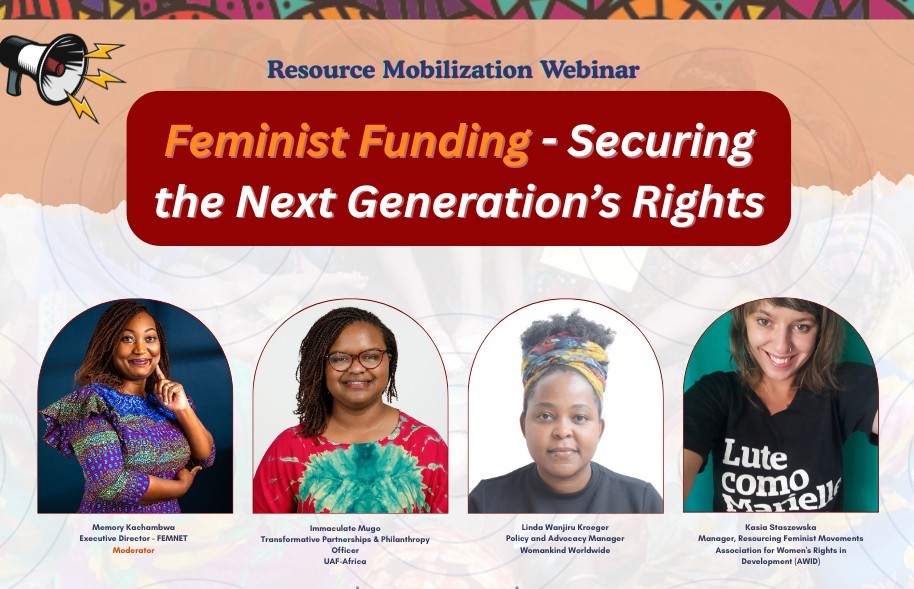
The ongoing realities shaped two recent webinars convened by FEMNET, bringing together feminist leaders, activists, and funders from across the continent to reflect on resource mobilization, sustainability, and the future of feminist funding in Africa. At the center of the conversations was one urgent question: How can feminist movements sustain themselves in increasingly resource-scarce environments?
For many organizations, funding uncertainty is not abstract; it is deeply personal. A grassroots women-led organization in the eastern Democratic Republic of Congo supporting survivors of conflict-related violence may not know whether it can continue operating beyond the next few months. Across the continent, many organizations are constantly balancing urgent community needs with limited financial support. As Memory Kachambwa, FEMNET’s Executive Director, argues, feminist organizations are not merely stretching scarce resources—they are holding communities together. They turn their homes into shelters, absorb the cost of essential services, and provide countless hours of counselling and care, all while doing work that states and institutions routinely fail to fund, recognize, or even see.
During the webinars, FEMNET’s Resource Mobilization Lead, Mary Mwangi, emphasized that relying solely on traditional donor funding is no longer enough. She encouraged organizations to diversify their approaches by exploring community philanthropy, local giving, responsible private sector partnerships, crowdfunding, payroll giving, and other creative fundraising models.
This shift is already happening in different ways across Africa. In Kenya, some feminist organizations are building stronger local donor communities through monthly giving initiatives. In Nigeria, activists are increasingly using digital fundraising during emergencies and civic protests. In South Africa, feminist collectives are experimenting with shared working spaces and collaborative fundraising to reduce costs while strengthening solidarity.
A rapid FEMNET survey of feminist organizations, movements, and networks across Africa’s five regions found that 55% had no financial reserves. Only 16% reported having enough reserves to sustain their work for one year, while the remainder said their reserves would last less than six months. Indicating the fragility of funding in the feminist movement. However, despite the funding, the participants noted that work will continue with advocacy leading, followed by training, documentation, and policy influencing.
