
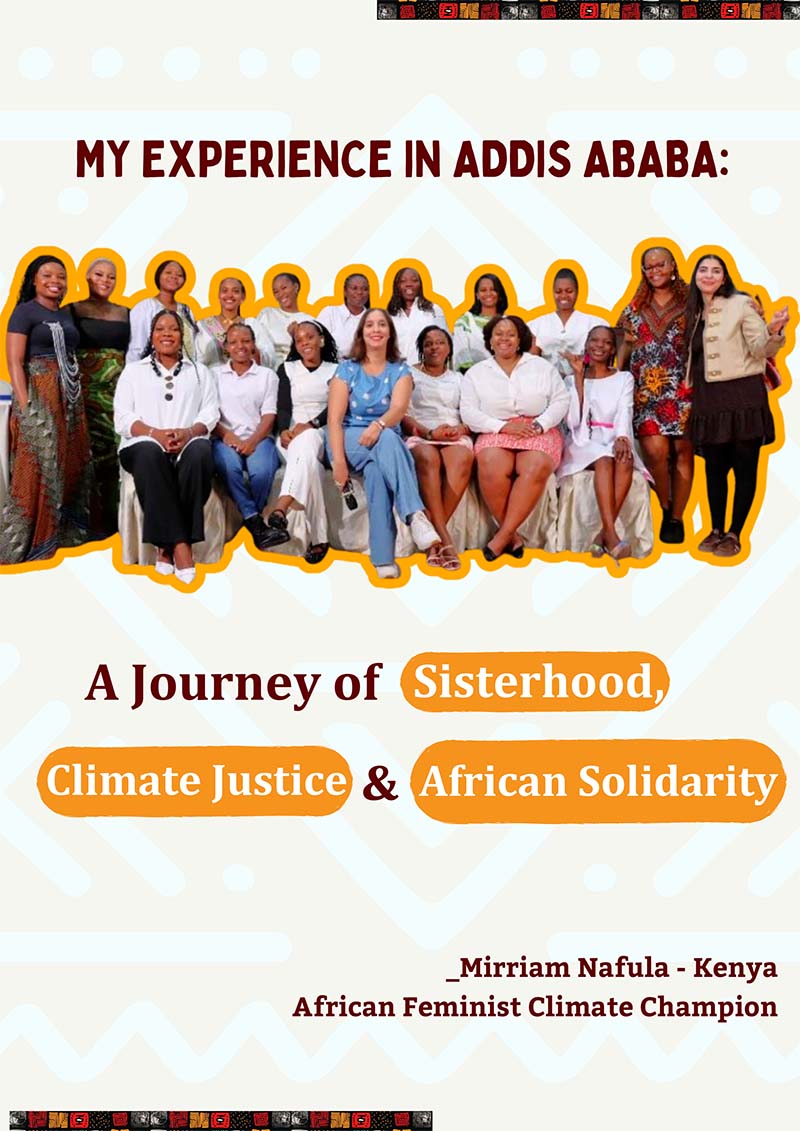
My Experience in Addis Ababa: A Journey of Sisterhood, Climate Justice & African Solidarity
By _Mirriam Nafula – Kenya – African Feminist Climate Champion
From my rural community of Bungoma in Kenya to the vibrant capital City of Addis Ababa-Ethiopia, I embarked on an unforgettable journey to join 20 young women from different African countries for the Africa Feminist Climate Justice Academy (AFCJA) hosted by FEMNET Secretariat (African Women’s Development and Communication Network).
This journey has offered us an incredible opportunity to learn, connect, experience a new culture and to reflect on the role of young African women in advancing climate justice. From the experience of my first international flight, I got an opportunity to meet and interact with passengers and exploring the beautiful skies and landscapes views of Kenya and Ethiopia it was such a fascinating experience.
Landing in Addis gave me a feeling that was both exciting and a new feeling from home, from the beautiful stunning infrastructure and a green and clean city to meeting with friendly people of Ethiopia, the warm reception, friendly taxi drivers and warm welcome to the hotel gave me a new experience of African spirit, indeed this is the Ubuntu.
To the writings on the streets of Addis, welcome to Addis Ababa, “a city that never sleeps ‘’shows the hard work and the resilient of the people of Addis’ ’where the city meets the sky’’ a show of the beautiful buildings and infrastructure of this great city made me feel home, the home of African Union inspired me to get to learn much about this city and country.
This visit wasn’t just an Academy it was much more to learn about the culture, language and Ethiopia in its diversity.
On the first day of the Academy i was really excited to meet with my African sisters doing amazing work in climate justice, interacting with them and learning from what they do, and to bringing new ideas in the room, we shared experiences, exchanged ideas, and learned from the different initiatives taking place across Africa.
From sharing the difference local experiences on climate change, we got the picture of the challenges women and girls face due to the devastated effects of climate change and the solutions developed by the young women to ensure the representation of women in climate negotiation rooms such as the COP was really motivating.
The stories inspired the commitments from the young women that climate change should not wait, its an urgent matter that needs the attentions of the global and local actors in making sure that decisions are Gender Responsive to the needs of women.
One of the most inspiring moments of the Academy was reflecting on the stories, writings, and history of African women who have made significant contributions to environmental protection, justice, leadership, and social transformation. We remembered and celebrated women whose courage continues to inspire generations.
We took a moment to remember and celebrate them in the room, we reflected on the legacy of Professor Wangari Maathai, the founder of the Green Belt Movement, whose work in environmental conservation, community empowerment, and climate justice continues to inspire people across the world. Her belief in the power of individual action reminds us that meaningful change often begins with the small actions that citizens take every day.
We also remembered Mekatilili wa Menza of coastal Kenya, whose courage and resistance continue to symbolize the protection of communities, culture, and indigenous heritage.
From Angola, we reflected on the leadership and courage of Queen Nzinga Mbande, whose determination and resilience challenged systems of oppression and demonstrated the power of women in leadership.
These stories reminded us that women have always been leaders of change. Across generations, African women have always defended their communities, protected their environments, challenged injustice, and contributed to building a more just and sustainable societies.
Their legacy continues to inspire today’s feminist movement and reminds us that women continues to participate in climate action.
As young female climate champions, we deepened our understanding of ecofeminism and explored the ways in which patriarchal systems and unequal power relations affect women and girls, particularly in the context of climate change.
The Academy also strengthened our understanding of climate communication. We explored the differences between misinformation, disinformation, and malinformation, and how information can influence public understanding and climate action.
Women and girls plays a key role in sustaining environmental and climatical development yet they are the most affected and more often underfunded ,we were able to analyze how climate financing patterns are done and how women can track the money from Global pledges, to Multilateral fund to national government to national NGOs to local organization and to local farmers who most often only benefits a fraction from the funding, whilest a lot of money is cut at every step of the cashflow. There was need to reduce on the channels so that the women and girls can meaningfully and fully benefit from the climate fund.
Our presence in Addis Ababa gave us an opportunity through FEMNET Kenya to visit the African Union Headquarters, (AU) a one in a lifetime experience that allowed us to understand the mandate of the AU and its importance in shaping Africa’s future.
The tour allowed us to appreciate the Africa’s investments in different sectors such as the Peace and Security where we visited the AU Wall of fame and paid respect to our fallen Soldiers who fought for the restorations of Peace in many African countries such as Somalia, Ethiopia and South Sudan. Through the Peace and Security Organ the AU is determined to end war and conflict through its initiatives of silencing the guns. This will ensure we have peaceful co-existence among member states and ethnic groups.
Touring the AU Chambers at the Nelson Mandela auditorium gave us the first-hand experience to be in the room where Head of States meet annually to deliberate on matters affecting Africa. The AU Experience inspired the young women to reflect on the Africa we have and to strive to achieve the African Union Agenda 2063 of the Africa we Want.
Alongside the happening of the Africa Feminist Climate Justice Academy we also got an opportunity to visit the CCDA XIV Conference happening at the United Nations Economic Commission for Africa (UNECA) in Addis Ababa on an observation mission. Through our participation we were able to observe how high-level climate negotiations are done, how statements are presented and how final texts are made until adoption. As upcoming young feminist negotiators, this gave us a great platform of inspiration on preparations to present Gender responsive statements even ahead of COP 31 in Turkiye and COP 32 in Addis Ababa-Africa. It was really a learning experience for us.
On the final day of the academy we were able to look at the Belem Gender Action Plan and how it addresses Gender Gaps, such as exclusion of gender equality and Human Rights from global policies. Through this we were asked to identify a gender climate focal person of our country and whether they have done a national country assessment as an action plan, when we get back home.
As part of the Global Week of Action the young feminists would join in solidarity the women and Gender constituency group in claiming September 17 as a global day of feminist gathering, with a one collective objective of bringing the Belem Gender Action Plan to life.
Each climate champion was encouraged to develop any action plan they can do to mobilize and organize whether small or big that could mobilize communities, build collective power, and advocate for the meaningful implementation of gender commitments in Belem Plan.
The participants from the academy were able to develop proposed initiatives for September 17 to amplify and call to action for the actualization of the Belem plan.
At mid-day we were able to do a climate simulation exercise on the Belem gender action plans and the positions of different parties such as member states, NGOs, women and farmers. It was really exciting to see how difference groups were able to defend their positions, a true reflection of what happens on real negotiations forums such as COP, UN and many other spaces. This exercise shaped our negotiating skills and how we can meaningfully represent different groups.
We later joined the climate justice validation exercise virtually on the literature review on what’s researched, what’s missing and whose knowledge counts in Africa done by FEMNET on the meta study review for African women, climate change and climate justice. We were able to add our ideas on the research findings ahead of its publishing.
Our one week in Addis was really a life changing experience for young women in climate justice, today we leave Addis powered with knowledge and skills on climate justice and climate negotiations, the academy has given us capacity to participate and represent our constituencies fully in places where decisions are made. We are Inspired, we are ready to make Climate Agenda a Gender Agenda because climate Justice is Gender Justice, this is our Commitment
