

Youth Voices at ARFSD12: Turning Presence into Policy Influence
Tulinde Future yetu Initiative
A reflective conference blog from Addis Ababa on women’s land rights, food sovereignty, climate-smart agriculture, and meaningful youth participation designed in SDG colors.
By a Kenyan youth delegate supported by FEMNET under the META programme | United Nations Conference Centre, Addis Ababa, Ethiopia | 27–30 April 2026
By Salim Chidzuga
Attending the 12th Africa Regional Forum on Sustainable Development in Addis Ababa was more than a conference experience for me it was a political and personal reminder that young people must not only be present in regional spaces, but must shape the conversations that determine Africa’s future. I joined the forum as a delegate supported by FEMNET under the META programme, carrying with me the responsibility of representing youth voices in discussions on development, justice, and inclusion.
Across the formal sessions, side events, and networking spaces, one theme stayed with me: sustainable development cannot be achieved through token participation. Whether the topic was women’s land rights, food systems, climate adaptation, or local economic resilience, the strongest ideas came from people closest to the realities on the ground especially rural women and young leaders.
“It is until we all agree to be feminist that we will truly say we are developed.”
Conference Journey
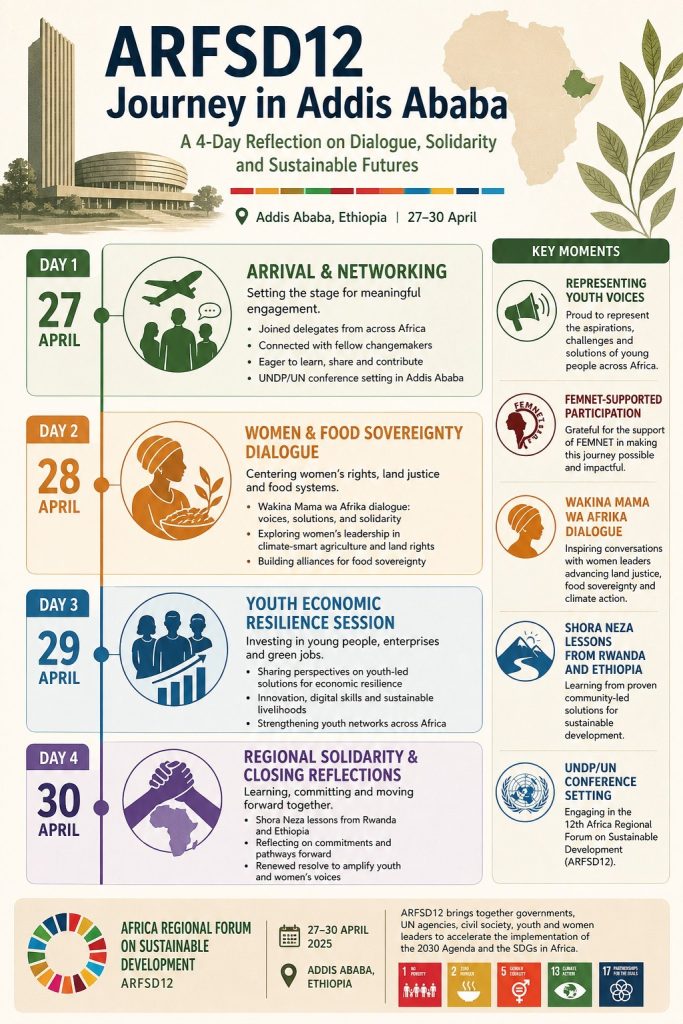
Why this forum mattered
ARFSD12 offered a powerful platform for connecting Agenda 2030 with Agenda 2063 in practical ways. For me, the value of the forum lay not only in attending plenaries and side events, but in seeing how continental policy debates intersect with everyday struggles over land, food, livelihoods, and dignity.
Sustainable development becomes real when it answers who has power, who owns productive assets, who is heard, and who gets left behind.
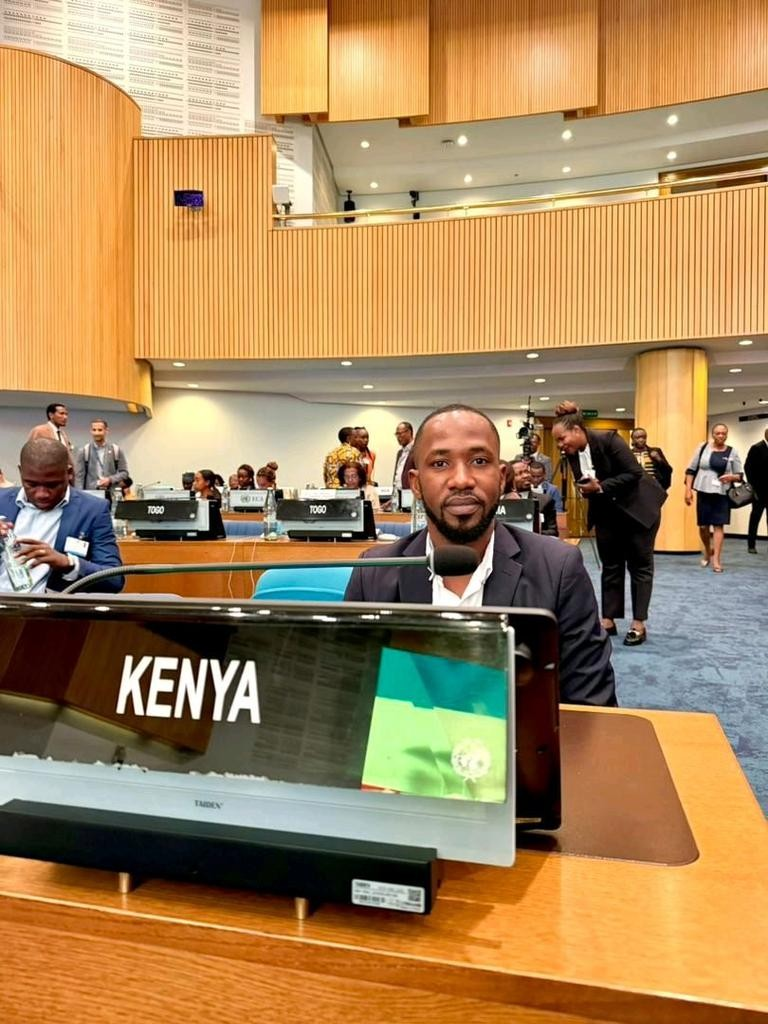
Day 1 reflections: women, land, and food sovereignty
WAKINA MAMA WA AFRIKA – Golden Tulip
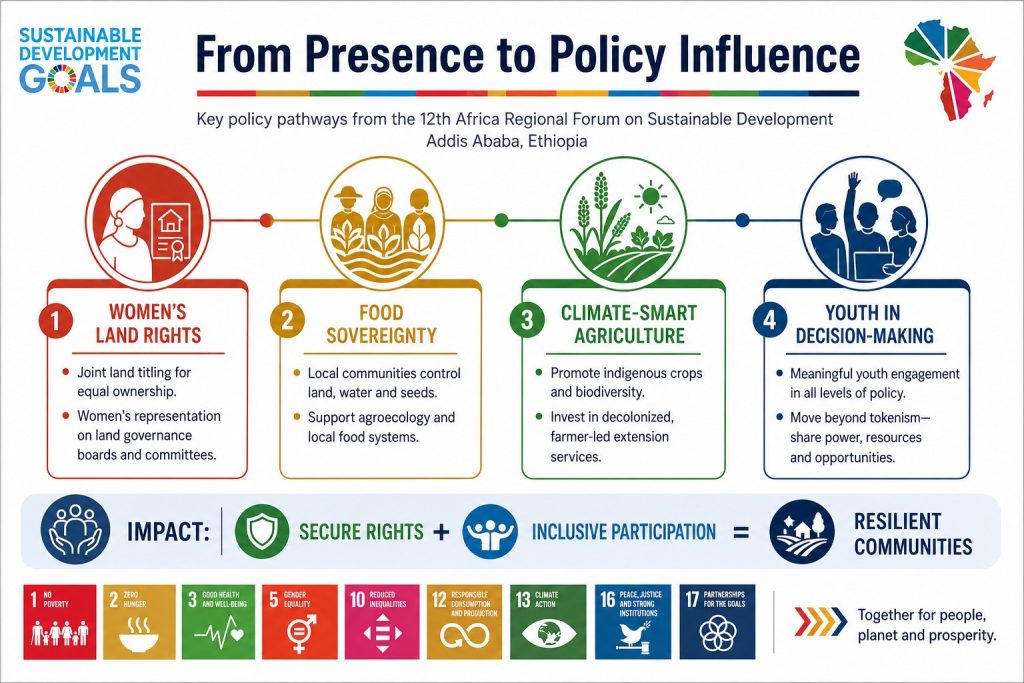
One of the most important discussions I joined focused on issues affecting women and how they can be addressed through structural, not symbolic, solutions. The conversation brought sharp attention to Africa’s food sovereignty struggle and the need to re-politicize it. At its heart, food sovereignty is about reclaiming the right of local communities not global corporations to decide how land, water, and seeds are governed and used.
This message became even more urgent when discussions turned to land injustice. Kenya has progressive legal frameworks, including the Constitution of 2010 and the Matrimonial Property Act. Yet in places such as Kwale, widows and displaced women still lose land to cartels, elite capture, and patriarchal systems. The gap between law on paper and justice in practice remains wide. That is why proposals such as joint land titling and guaranteed women’s seats on Land Boards are not side issues, they are core development interventions.
The conversation also challenged how Climate-Smart Agriculture is often framed. Climate resilience cannot depend on expensive imported packages that rural women cannot access or trust. Extension systems must be decolonized by valuing indigenous knowledge, local seed systems, and drought-tolerant crops already tested by communities. If women cannot access information, services, and decision-making power, then climate-smart agriculture will remain a slogan rather than a solution.
- Food sovereignty means restoring decision-making power over land, water, and seeds to local communities.
- Women’s land rights require implementation tools such as joint titling, legal literacy, and representation on Land Boards.
- Climate-smart agriculture must center indigenous knowledge, local crops, and accessible extension services.
- Regional forums fail when rural women are treated as passive beneficiaries instead of expert stakeholders.
The bottom line from this discussion was clear: empowering women with legal literacy and secure land ownership is one of the most effective ways to grow Africa’s economies while breaking cycles of food dependency. Development cannot be measured only by growth indicators; it must also be judged by whether women can own, decide, inherit, cultivate, and lead.
Day 2 reflections: community voices and local economic resilience
Session CR-4 | 13:00–14:30
The session on “Community Voices Driving Local Economic Resilience” explored youth empowerment as a foundation for resilient and inclusive communities in Africa. Drawing from lessons in Rwanda’s Shora Neza project and experiences from Ethiopia, the discussion reframed youth from being recipients of development to being architects of it. The examples showed how youth-led action is already advancing sustainable development through Agri-economy, leadership, and digital innovation.
The session highlighted major barriers that continue to hold young people back: limited economic empowerment, inadequate entrepreneurial training, and exclusion from decision-making spaces. Instead of reducing the challenge to “youth unemployment,” the discussion located the problem in deeper systems that deny young people access to capital, trust, platforms, and policy influence. That distinction matters because it shifts responsibility from individual young people to institutions that must change.
From Presence to Policy Influence
One of the most inspiring findings was that among the seven youth groups presented, five were women-led. That was more than a statistic; it was evidence that intentional investment in young women produces strong leadership returns. The conversation also underscored that meaningful youth engagement is not optional. It is the precondition for both democratic governance and broad-based
economic resilience. Youth inclusion must therefore be designed into local planning, digital transformation strategies, and agricultural innovation systems.
- Youth-led initiatives in Rwanda and Ethiopia demonstrated viable and scalable models in Agri-economy and digital innovation.
- Five of the seven youth groups showcased were women-led, proving the value of intentional support to young women.
- The biggest obstacle is systemic exclusion from economic and political spaces, not a lack of youth potential.
- Meaningful youth engagement — not tokenism — is essential for resilient local development and democratic legitimacy.
My strongest lesson from ARFSD12 is that development spaces must move beyond invitation toward redistribution of influence. Young people cannot remain on the margins of conversations about economic reform, climate resilience, and governance. Likewise, rural women cannot continue to be described as vulnerable while their expertise, labour, and leadership are ignored. Real progress requires structural inclusion: legal reforms that are implemented, policy spaces that share power, and resource systems that trust local knowledge.
As I reflect on Addis Ababa, I leave with renewed conviction that the future of Africa will not be built by distant institutions acting alone. It will be built by communities defending land rights, by women claiming economic and political power, and by young people refusing to be reduced to observers in decisions that shape their lives. If Agenda 2030 and Agenda 2063 are to mean anything, they must be grounded in the principle of “nothing for us without us.”
“Secure land rights, feminist leadership, and meaningful youth participation are not side conversations — they are the pathway to resilient African communities”
Selected takeaways for advocacy
- Push for joint land titling and women’s representation on land governance bodies.
- Treat rural women as policy experts, not merely beneficiaries of aid or programmes.
- Redesign extension services around indigenous knowledge and locally adapted crops.
- Create economic systems that trust youth with leadership, innovation, and governance roles.
- Use regional forums to amplify community-rooted solutions rather than symbolic