
Being There: My Experience at The African Feminist Care Academy
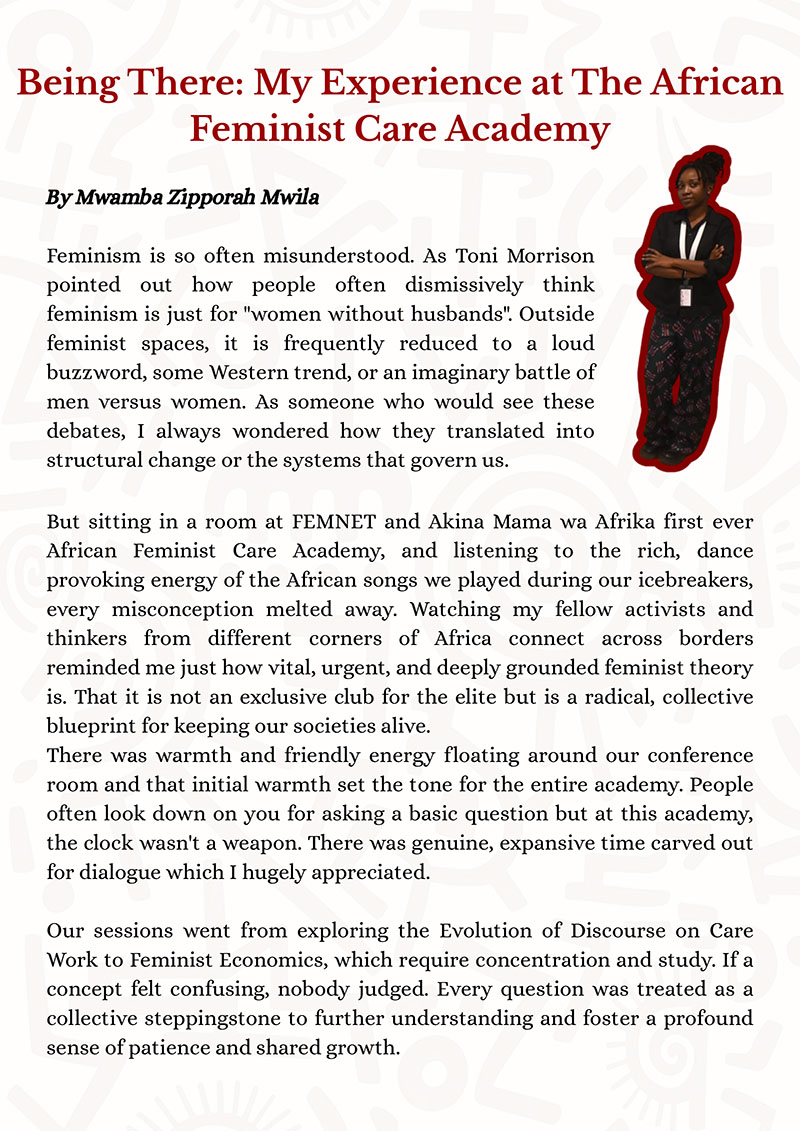
By Mwamba Zipporah Mwila
Feminism is so often misunderstood. As Toni Morrison pointed out how people often dismissively think feminism is just for “women without husbands”. Outside feminist spaces, it is frequently reduced to a loud buzzword, some Western trend, or an imaginary battle of men versus women. As someone who would see these debates, I always wondered how they translated into structural change or the systems that govern us.
But sitting in a room at FEMNET and Akina Mama wa Afrika first ever African Feminist Care Academy, and listening to the rich, dance provoking energy of the African songs we played during our icebreakers, every misconception melted away. Watching my fellow activists and thinkers from different corners of Africa connect across borders reminded me just how vital, urgent, and deeply grounded feminist theory is. That it is not an exclusive club for the elite but is a radical, collective blueprint for keeping our societies alive.
There was warmth and friendly energy floating around our conference room and that initial warmth set the tone for the entire academy. People often look down on you for asking a basic question but at this academy, the clock wasn’t a weapon. There was genuine, expansive time carved out for dialogue which I hugely appreciated.
Our sessions went from exploring the Evolution of Discourse on Care Work to Feminist Economics, which require concentration and study. If a concept felt confusing, nobody judged. Every question was treated as a collective steppingstone to further understanding and foster a profound sense of patience and shared growth.
Our learning sessions were active and tactical to keep us all in tune. The facilitators asked us to scribble our thoughts, opinions and expectations on colorful sticky notes and paste them on the walls. There is a science behind the physical act of writing things down. And so, this act, although small, locked the information firmly into our memories and allowed us a chance to reflect on our teachings and make sure we were all on the same page.
The dedicated session to sharing our own work with everyone in the room allowed us to swap strategies and see the direct parallels between our efforts and the work of peers in different countries across Africa, who are fighting the same battles, proving we are all part of a unified continental network.
As a massive coffee enthusiast, I was happy to be able to walk to the snacks corner of our conference room, to the shiny ern with hot coffee as much as I would like. Our physical wellbeing was taken as seriously as our learning sessions. All these heavy intellectual sessions were punctuated by healthy breakfasts, fresh lunches and much needed mid-session snacks for that extra boost of energy to battle Lusaka’s super-hot afternoons. Balancing a hot, rich cup of coffee while mapping out macroeconomics made the intense session work feel deeply supported and sustainable.
With our minds sharp and our bodies fed, we dove into more of the history, math and theoretical frameworks surrounding care work. What key considerations of Social Provisioning Approach to the economy, valuing care work and the goals of Feminist Economics to scrutinize economics, explain gender inequalities and strive for more equitable societies where women’s subordinate position is eliminated. We mapped out how colonial capitalism historically stripped economic value away from the communal care networks of African societies, forcing vital human labor to become invisible, unpaid domestic work.
Unlocking the math behind care work by looking at structural data and time use surveys as essential tools for measuring how individuals allocate their time across various activities, provided valuable insights into both paid and unpaid work. Coupling this with Social Reproduction Theory proved that global markets would collapse without this unpaid foundation. Seeing these historical and mathematical pieces slide into place completely transformed my understanding while also proving that recognizing care work is essential for collective empowerment.
A notable turning point of the academy was the site visit to the Zambia library, cultural and skills center for the blind and visually impaired. Stepping out of our conference room to witness the extra real-life work needed for community care work and seeing the structural gaps firsthand was saddening but at the same time a fire ignited in me to advocate for care work to be recognized and more underfunded care spaces to be uplifted. It also proved that Feminist economics as seen through an African lens, is a rigorous and essential tool for real world transformation and not just text in a book or website post.
On the final day, we were awarded participation certificates. As a jack of all trades, I was able to flex my photography muscle and capture the special moment everyone received their award. It was such a great feeling holding the certificate surrounded by this new continental family. I left the academy knowing that an economy that centers care is not just a niche idea, but an urgent future that through all the learning and teachings from the academy we are officially equipped to build together
