
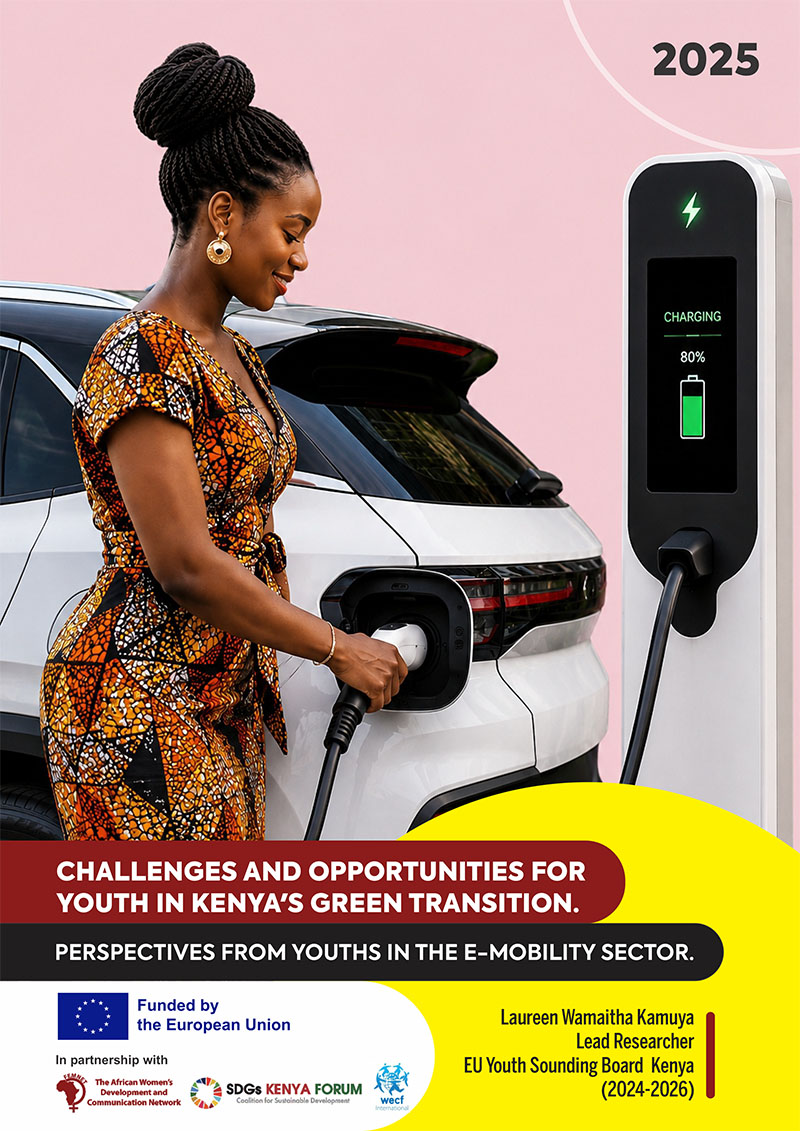
Challenges and Opportunities for Youth in Kenya’s Green Transition
Executive Summary
Kenya’s transition to green mobility presents a unique opportunity to advance climate change mitigation, youth employment, and sustainable urbanization. Despite growing youth engagement as electric vehicle (EV) owners, boda boda riders, delivery operators, and charging station technicians, structural barriers such as limited access to finance, technology, skills, and supportive policy frameworks continue to constrain their participation. Weak alignment between education systems and emerging green economy needs further limit youth preparedness for entrepreneurial and informal opportunities within the rapidly evolving e-mobility sector.
Although the e-mobility sector is expanding, there remains limited empirical evidence on youth engagement, perceptions, challenges, and opportunities. This knowledge gap risks policy misalignment and missed opportunities to harness Kenya’s youthful population for an inclusive, low-carbon transition. To address this gap, the study sought to assess the challenges and opportunities of green mobility within Kenya’s green transition ecosystem, focusing on youth engagement. The specific objectives were to assess youth perceptions of the green transition, evaluate the challenges and enabling factors influencing participation in the e-mobility sector, identify opportunities for growth, and provide policy and programmatic recommendations to enhance youth inclusion, employment, and voice in the sector.
The research was conducted between June and September 2025 using a qualitative method including 6 focus group discussions (FGDs), 9 key informant interviews (KIIs), and literature review across six urban and peri-urban areas such as Nairobi, Mombasa, Kisumu, Thika, Kitengela, and Rongai. Qualitative data obtained during the study were transcribed and coded using NVivo software to identify recurring themes, relationships, and emerging trends.
Findings reveal that economic motivations such as reduced fuel costs, higher earnings from digital platforms, and entrepreneurship prospects are the primary drivers of youth participation in e-mobility, while environmental motivations remain minimal due to limited awareness of climate and sustainability benefits. Major barriers include high upfront costs and limited access to affordable finance, declining battery quality, inadequate charging infrastructure, shortage of skilled technicians, and gender- and disability-based exclusion in ownership and employment. Weak policy awareness, fragmented regulation, and delayed government response further undermine sectoral growth.
Kenya’s e-mobility transition is youth-driven but structurally constrained. To unlock its full potential, the study recommends expanding inclusive financing for youth, women, and persons with disabilities; strengthening localized charging infrastructure and quality control standards; integrating green and technical skills into TVET and entrepreneurship programs; and enhancing policy coherence, coordination, and public awareness. By amplifying youth perspectives, this study provides evidence-based insights to guide Kenya’s inclusive, low-carbon, and job-creating green mobility transition.