
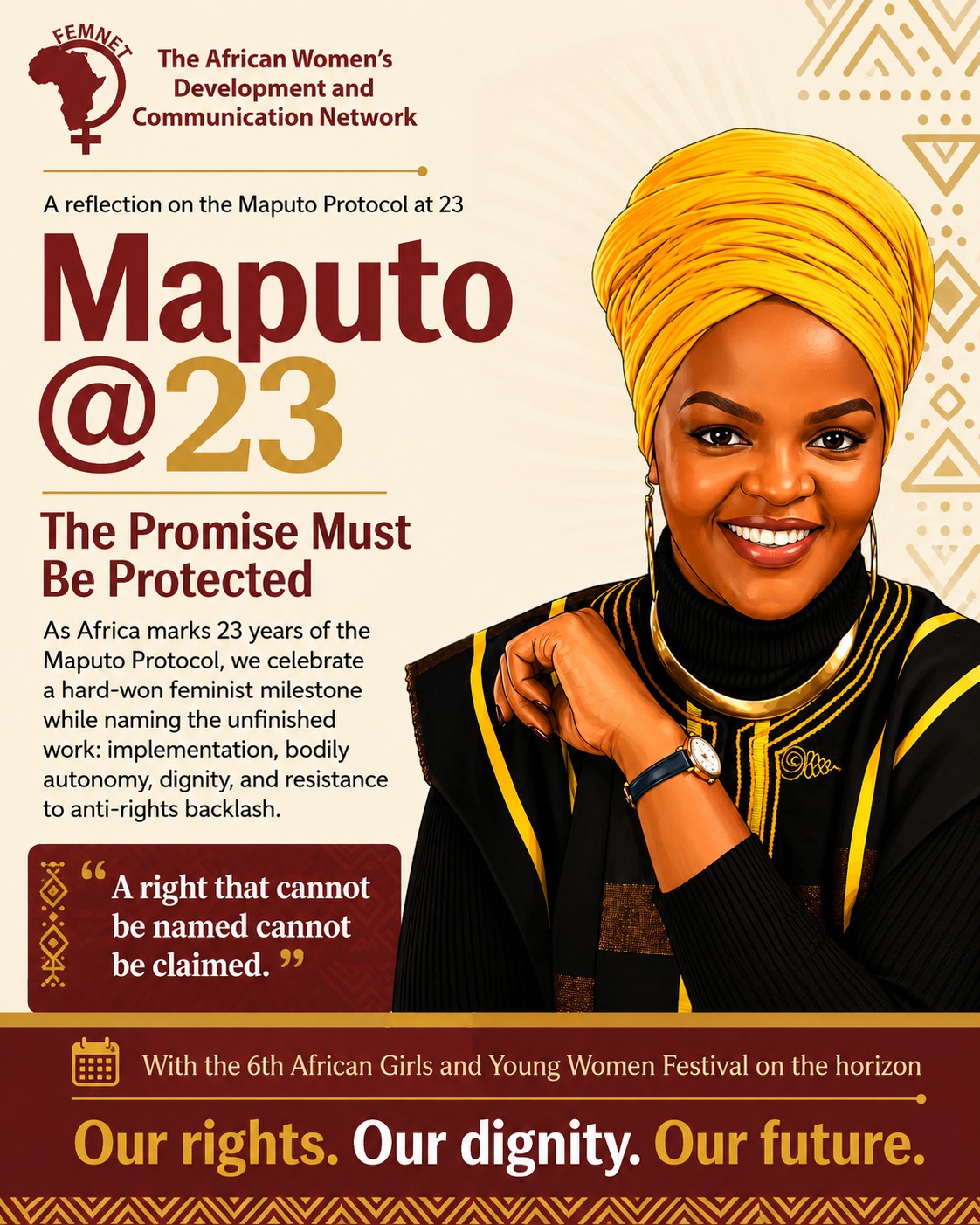
Maputo@ 23: The Promise Must Be Protected
I celebrate the Maputo Protocol with gratitude, but also with restlessness.
Gratitude because the Protocol remains one of the clearest political and legal reminders that African women and girls have a right to live with dignity, safety, autonomy and power. It is a reminder that women’s rights are not foreign to Africa. They are not borrowed language. They are not imported values. They are part of Africa’s own imagination of justice.
But I am restless because, 23 years later, too many African girls and young women are still being asked to survive the very harms the Protocol promised to end.
A girl can live in a country that has ratified the Maputo Protocol and still be forced into marriage. A young woman can live under laws that speak of equality and still be denied sexual and reproductive health information. A survivor can be protected in policy and still be blamed at home, dismissed at the police station or silenced by her community.
So yes, we must celebrate the Maputo Protocol. But we must not celebrate it in a way that makes us forget the work that remains.
The Protocol speaks to bodily autonomy, sexual and reproductive health and rights, protection from violence, harmful practices, education, participation, peace, dignity and justice. These are not abstract legal ideas. They are the daily conditions that determine whether a girl gets to stay in school, whether a young woman can make decisions about her body, whether a survivor is believed, whether a girl in a conflict zone is protected, and whether young women can participate in shaping the future of their communities.
This is why the Protocol still matters.
It gives us language. It gives us a framework. It gives us a standard against which governments must be measured. It reminds us that African states have already made commitments to women and girls. The issue is not whether the promise exists. The issue is whether the promise is being delivered.
And this is where the discomfort begins.
Across the continent, we are watching anti-rights actors become more organised, more strategic and more confident. They are using the language of family, culture, morality and protection to push back against bodily autonomy, comprehensive sexuality education, adolescent girls’ agency, sexual and reproductive health and rights, family law reform and feminist organising.
We need to be honest about what is happening.
When people say they are protecting the family, many times they are protecting control. When they say they are protecting culture, many times they are protecting silence. When they say they are protecting girls, many times they are denying girls the information, services and choices they need to actually be safe.
For girls and young women living through conflict, this pushback is even more dangerous. It determines whether they are believed after violence. Whether they can access care. Whether early and forced marriage is challenged. Whether their bodies are treated as sites of protection or control. Whether their voices count in peace and recovery.
This is why the Maputo Protocol must not be treated as a document that belongs only to lawyers, governments or regional institutions. It must belong to the girls and young women whose lives are shaped by the rights it protects.
Because a right that cannot be named cannot be claimed.
If girls and young women do not know that the Maputo Protocol speaks to their bodies, their safety, their education, their health, their leadership and their dignity, then we have not done enough. If communities do not understand that the Protocol is an African instrument born out of African women’s organising, then anti-rights actors will continue to lie that women’s rights are foreign. If governments can celebrate ratification while failing to implement, then our advocacy must become sharper.
At 23, the Maputo Protocol asks us to hold two truths at once.
The first is that we have inherited something powerful. African women fought for a framework that recognises our rights in full. That must never be taken lightly.
The second is that a powerful instrument is not enough if it does not change the daily lives of girls and young women.
Implementation must be felt in homes, schools, hospitals, courts, police stations, parliaments, refugee settlements, digital spaces, rural communities and conflict zones. It must be felt when budgets are made. It must be felt when laws are enforced. It must be felt when survivors seek justice. It must be felt when young women speak and are not punished for refusing silence.
This is also the spirit we are carrying into the 6th African Girls and Young Women Festival, Umu Ada: Daughters of the Soil. The Festival will bring girls and young women into conversation on peace, dignity, bodily autonomy and reparative justice. But more than that, it reminds us that girls and young women are not visitors to Africa’s political future. They are daughters of the land. They belong here. Their voices belong in the centre.
As we mark 23 years of the Maputo Protocol, I am thinking about what it means to protect a promise.
It means defending the Protocol from anti-rights attacks.
It means making it accessible to girls and young women.
It means refusing to separate bodily autonomy from peace, or dignity from justice.
It means insisting that African women’s rights are not negotiable every time power feels threatened.
It means asking governments to move beyond signatures, speeches and anniversaries.
Twenty-three years later, the question is not whether Africa has promised rights to women and girls.
The question is whether Africa is ready to deliver them.
And until that promise is felt in the lives of girls and young women, our work is not done.