
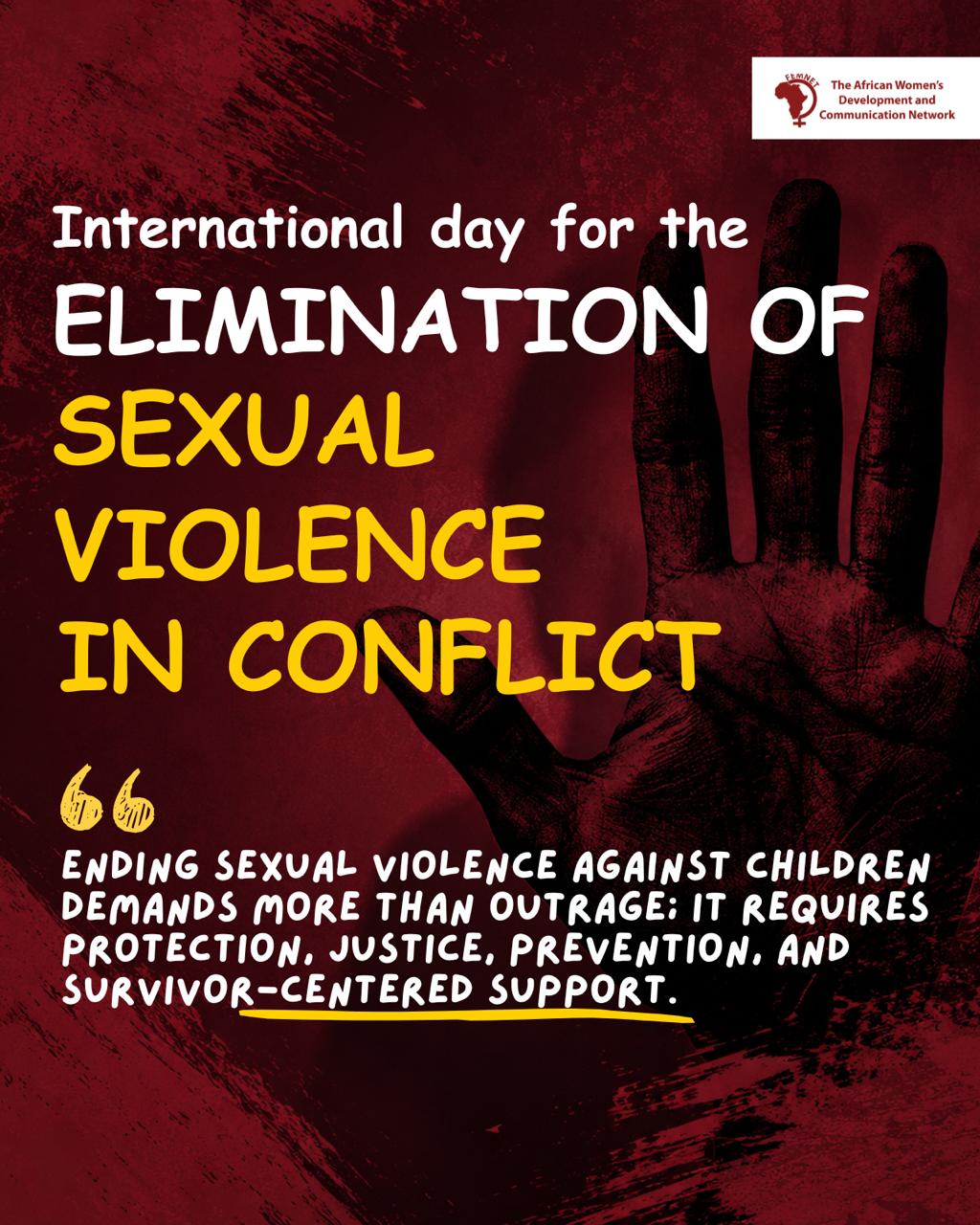
Ending Conflict-Related Sexual Violence in Africa Requires Justice, Accountability, and Feminist Action
Every year on 19 June, the world marks the International Day for the Elimination of Sexual Violence in Conflict, a day established by the United Nations to honor survivors, recognize the devastating impact of conflict-related sexual violence (CRSV), and renew commitments to ending its use as a weapon of war. Yet for millions of women, girls, men, and boys living in conflict-affected communities across Africa, sexual violence remains a lived reality rather than a historical memory.
Conflict-related sexual violence is not an inevitable by-product of war. It is a deliberate strategy used to terrorize communities, displace populations, punish perceived enemies, destroy social cohesion, and assert control. Across Africa’s conflict settings from Sudan and the Democratic Republic of Congo (DRC) to South Sudan, Ethiopia, Nigeria, Mozambique, and the Sahel, sexual violence continues to be deployed as a weapon of war and repression with devastating consequences for survivors, families, and entire communities.
The Reality of Conflict-Related Sexual Violence in Africa
Africa has experienced some of the most documented and prolonged manifestations of conflict-related sexual violence globally. Research indicates that between 1990 and 2023, nearly three-quarters of African countries experienced conflict situations involving sexual violence. These violations have included rape, gang rape, sexual slavery, forced pregnancy, forced marriage, sexual torture, forced nudity, and other forms of gender-based violence perpetrated by both state and non-state actors.
In eastern DRC, sexual violence has long been described as one of the defining features of the conflict, affecting women and girls on a massive scale. Recent escalations involving armed groups and state actors continue to generate reports of rape, gang rape, and other forms of sexual violence against civilians. The ongoing conflict in Sudan presents another alarming example. Reports from Darfur and other conflict-affected regions reveal widespread sexual violence targeting women and girls during attacks on communities, displacement routes, and humanitarian settings. Humanitarian organizations have documented hundreds of cases within short periods, suggesting that reported incidents represent only a fraction of the actual scale of violations.
Across South Sudan, Ethiopia, northern Nigeria, and other fragile contexts, women and girls continue to face systematic sexual violence perpetrated by armed groups, militias, and security forces. Increasingly, reports indicate that children and infants are also being targeted, demonstrating the extreme brutality and dehumanization associated with these crimes.
Sexual Violence as a Tool of Power and Control
A feminist analysis reminds us that conflict-related sexual violence cannot be understood solely through a security or humanitarian lens. Rather, it is deeply rooted in patriarchal systems that normalize gender inequality, militarized masculinities, and the control of bodies.
Conflict amplifies pre-existing inequalities. Women and girls often enter conflict already experiencing discrimination, economic exclusion, limited access to justice, and violence in both public and private spaces. During conflict, these inequalities are weaponized. Sexual violence becomes a mechanism for reinforcing power hierarchies based on gender, ethnicity, political affiliation, disability status, age, and other intersecting identities.
Importantly, CRSV is not only about physical violence. It is also about the destruction of agency, dignity, bodily autonomy, and community belonging. Survivors frequently experience long-term psychological trauma, social exclusion, forced displacement, loss of livelihoods, unwanted pregnancies, sexually transmitted infections, and barriers to accessing healthcare and justice.
A feminist response, therefore, requires moving beyond narrow criminal justice approaches to embrace survivor-centered, trauma-informed, rights-based, and intersectional interventions that recognize the full spectrum of harms experienced by survivors.
Progress Without Accountability
Africa has made important normative and legal commitments to address gender-based violence and protect women in conflict settings.
Key frameworks include the Protocol to the African Charter on Human and Peoples’ Rights on the Rights of Women in Africa (Maputo Protocol), the African Charter on Human and Peoples’ Rights, the African Union Convention on Ending Violence Against Women and Girls, the Solemn Declaration on Gender Equality in Africa, the Women, Peace and Security agenda under United Nations Security Council Resolution 1325 and subsequent resolutions, National Action Plans on Women, Peace and Security adopted across several African countries.
These frameworks collectively recognize sexual violence as a serious violation of human rights and international humanitarian law. They also establish obligations for states to prevent violations, protect survivors, prosecute perpetrators, and provide reparations.
However, the challenge across many contexts is not the absence of frameworks but the persistent gap between commitment and implementation. Analysts have increasingly pointed to weaknesses in enforcement mechanisms, limited political will, inadequate survivor support systems, underfunded justice institutions, and widespread impunity. Survivors often face significant barriers to reporting violations, including insecurity, stigma, fear of retaliation, and lack of confidence in justice systems.
What Is Currently Working?
Despite these challenges, important efforts are underway across the continent.
Women’s rights organizations, feminist movements, survivor networks, community-based organizations, and humanitarian actors continue to provide life-saving support services, psychosocial care, legal aid, sexual and reproductive health services, safe spaces, and economic reintegration programs.
At the regional level, the African Union has increasingly recognized the importance of addressing conflict-related sexual violence within peace and security discussions. Recent engagements by the AU Peace and Security Council have highlighted concerns regarding CRSV in contexts such as Sudan and eastern DRC.
There is also growing recognition that survivors must be involved in designing policies, accountability processes, and recovery programs. Survivor leadership and feminist movement-building are increasingly shaping conversations on justice, reparations, and peacebuilding across Africa.
What Must Be Done Next?
As Africa marks the International Day for the Elimination of Sexual Violence in Conflict, commemoration must be matched with action.
- Governments and regional institutions must strengthen accountability mechanisms and end impunity for perpetrators. This includes strengthening investigations, supporting survivor participation in justice processes, and ensuring that CRSV cases are effectively prosecuted.
- Survivor-centered services must be adequately funded and accessible. Medical care, psychosocial support, sexual and reproductive health services, legal assistance, and economic recovery programs should be treated as essential services rather than optional interventions.
- African governments must fully implement regional and international commitments, including the Maputo Protocol, AU CEVAWG, and Women, Peace and Security obligations.
- Peacebuilding and mediation processes must meaningfully include women, feminist organizations, and survivors. Sustainable peace cannot be achieved while survivors remain excluded from decision-making spaces.
- Donors and international actors must invest in local women’s rights organizations that are often the first responders in conflict settings. Yet these organizations continue to receive only a fraction of available humanitarian and peacebuilding resources.
- We must challenge the structural inequalities that enable sexual violence to flourish before, during, and after conflict. Ending CRSV requires transforming the patriarchal systems that normalize violence, silence survivors, and shield perpetrators from accountability.
Conflict-related sexual violence is not merely a women’s issue. It is a peace and security issue, a development issue, a human rights issue, and a justice issue.
On this International Day for the Elimination of Sexual Violence in Conflict, Africa must move beyond symbolic commitments and embrace transformative action. Survivors deserve more than recognition. They deserve justice. Communities deserve more than protection. They deserve lasting peace. And future generations deserve an Africa where bodies are never used as battlefields and where conflict can no longer be sustained through violence against women, girls, and marginalized populations.
The time for accountability is now!
References
UN International Day for the Elimination of Sexual Violence in Conflict. https://www.un.org/en/observances/end-sexual-violence-in-conflict-day
ISS Africa (2025). Conflict-related sexual violence: a threat to Africa’s peace and security. https://issafrica.org/iss-today/conflict-related-sexual-violence-a-threat-to-africa-s-peace-and-security
AfricLaw (2026). Conflict-Related Sexual Violence and the Accountability Gap in Africa’s Regional Human Rights Architecture. https://africlaw.com/2026/03/03/conflict-related-sexual-violence-and-the-accountability-gap-in-africas-regional-human-rights-architecture
Babatope, A.E. (2025). Patterns and Dynamics of Conflict-Related Sexual Violence in Africa.
Berkeley Human Rights Center (2016). Improving Accountability for Conflict-Related Sexual Violence in Africa.
UNFPA. International Day for the Elimination of Sexual Violence in Conflict. https://www.unfpa.org/events/international-day-elimination-sexual-violence-conflict
UNSCR 1325, 1820, 1888, 1960 and subsequent Women, Peace and Security resolutions.
Maputo Protocol (2003).
African Union Convention on Ending Violence Against Women and Girls (AU CEVAWG).
Baaz, M. & Stern, M. Sexual Violence as a Weapon of War?
Wood, E. J. (2009). Armed Groups and Sexual Violence in Conflict.
Mukwege Foundation (2025). Statement on the International Day for the Elimination of Sexual Violence in Conflict.