
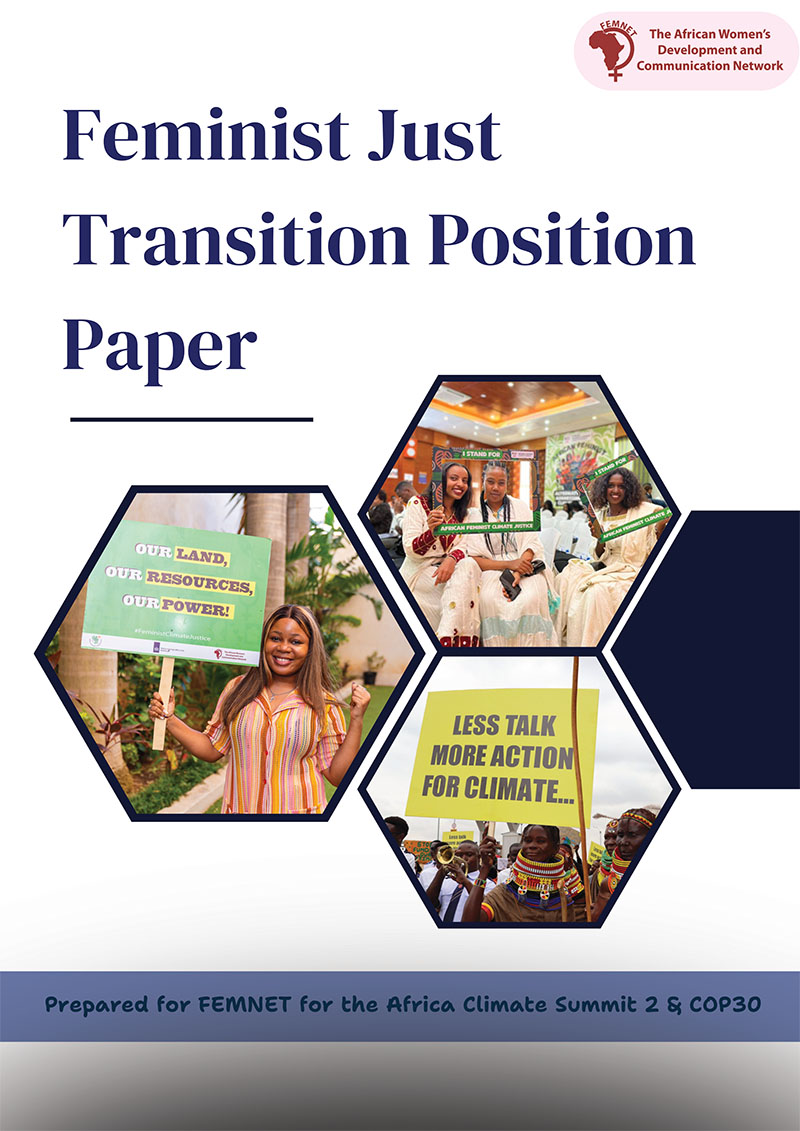
Feminist Just Transition Position Paper
Africa stands at a critical juncture. Though it contributes less than 4% of global emissions, the continent bears disproportionate climate impacts. At the same time, Africa holds 30% of the world’s transition minerals and has the highest renewable energy potential—39% of the global share and 60% of the best solar resources (AU, 2023; Fossil Fuel Non-Proliferation Treaty Initiative, 2023). These realities mean Africa faces the worst impacts of the climate crisis but is also at the centre of its solutions, with the opportunity to move directly from energy poverty to an equitable renewable future that delivers access for all.
Yet this future cannot be realised without confronting the structures that have long extracted from Africa rather than served it. Women’s lives make this visible. Across the continent, women sustain communities through agriculture, care systems, and renewable energy initiatives, yet they remain systematically excluded from decision-making and finance. Women shoulder 80% of climate impacts but receive only 2% of climate finance (GGGI, 2024). Their exclusion is not accidental—it reflects the same extractive logic that has left 600 million Africans without electricity and nearly 1 billion without clean cooking, while fossil fuel corporations profit (UNSDG, 2025; IEA, 2025).
This extractive model is collapsing under its own weight. Fossil fuels have failed to deliver energy access. Debt servicing drains resources desperately needed for adaptation, while austerity cuts health, education, and care systems that women and communities depend on. Extractive industries dispossess people of land, water, and livelihoods, with women facing the sharpest edge of violence and displacement. Those who resist, particularly Environmental Women Human Rights Defenders (EWHRDs), are met with harassment, criminalisation, and
even physical attack. Meanwhile, climate finance is delivered as loans that deepen debt, and colonial tax systems continue to enable multinational corporations to siphon Africa’s wealth: the continent loses $89 billion annually to illicit financial flows—more than it receives in climate finance (UNCTAD, 2020; African Development Bank, 2024).
A feminist just transition offers a different path. It centres women’s leadership and lived experience, challenges extractive economic models, and reimagines development through care, equity, and sovereignty. It recognises that care work is not peripheral but core infrastructure—every bit as essential as roads, water, and electricity. It envisions communities owning and controlling their energy systems. And it demands not only decarbonisation but also decolonisation of finance, trade, and governance systems, so that they redistribute power and resources rather than extract them.
What follows are the policy priorities articulated by African feminist movements: concrete shifts to put power, resources, and decision-making where they belong—in the hands of those building the solutions.