
Justice Must Reach the Last Mile: A Story from Kenya’s ASAL Communities
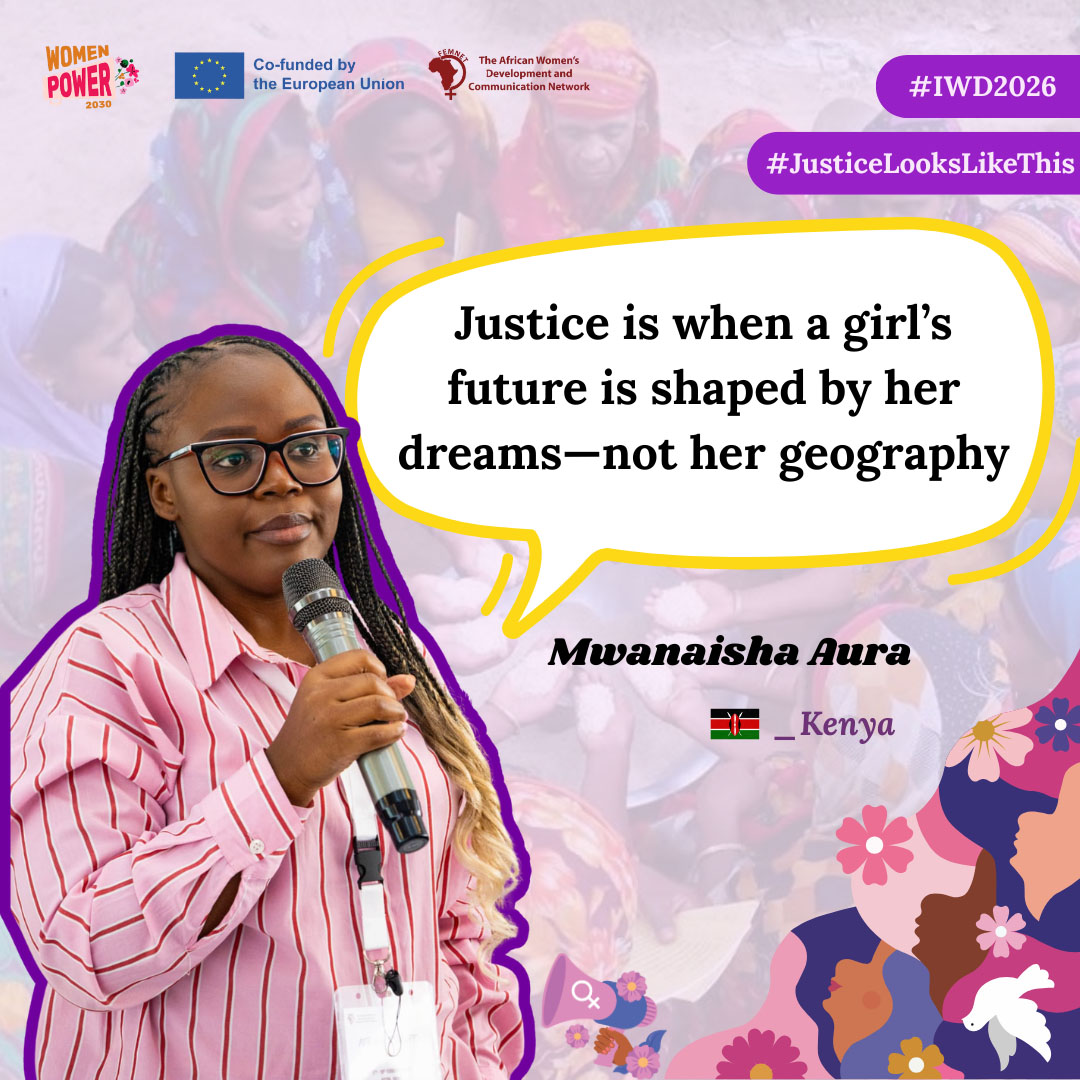
My name is Mwanaisha Aura, from Kenya. To me, justice means a world where a girl’s dreams are not determined by her geography, gender, culture, or circumstance.
I carry this belief with me when I think about girls like Amina—growing up in Kenya’s Arid and Semi-Arid Lands (ASAL). Her story is not isolated; it reflects the lived reality of many girls whose aspirations are often shaped, and sometimes limited, by where they are born.
In these regions, opportunity can feel distant. Not just because of physical remoteness, but because of deeply rooted cultural practices and restrictive interpretations of religion that quietly, yet powerfully, define what a girl can or cannot become.
Amina’s daily life is marked by long walks to school—if she can attend at all. Access to health services is limited, and when available, often not youth-friendly. Too many girls face the risk of early and forced marriage, while societal expectations continue to prioritize boys’ education over girls’ futures.
In such contexts, I have come to understand that justice is not abstract. It is not just about policies written in documents. Justice is about access.
It is about having a safe school within reach.
It is about accessing health services without fear or stigma.
It is about digital connectivity that opens up the world.
And it is about honest, ongoing community conversations that challenge harmful norms while honoring the richness of our cultural identity.
I believe deeply in the beauty of our traditions. Culture gives us belonging, pride, and continuity. But I also believe that culture must grow with us. It should never be used as a reason to limit a girl’s education, her bodily autonomy, her leadership, or her economic potential.
We can celebrate who we are while still asking hard questions about what must change.
Justice, to me, means creating space for communities to evolve—to hold on to what uplifts us and let go of what holds girls back. It is about choosing progress without losing identity.
That is why I call upon the Government of Kenya, county governments in ASAL regions, religious and cultural leaders, and development partners to act with intention. We must invest in girls from marginalized communities through fully funded education, stronger protection systems against child marriage and gender-based violence, accessible sexual and reproductive health services, and sustained dialogue that shifts social norms in meaningful ways.
Because justice must reach the last mile.
Girls like Amina should not have to fight harder simply because of where they were born. Every girl deserves the chance to dream freely, to make informed choices, and to grow in a community that stands with her—not against her.
Related Tags
Related Posts
Justice Must Be Lived, Not Just Written: My Call from Ghana
My name is Lois Aduamoah-Addo, and I come from Ghana in West Africa, where I work with the [...]
Learn More
When Justice Meets Climate Reality: A Voice from Turkana
My name is Jemimah Nyangasi Wabuko, and I come from Kenya. For me, justice is not an abstract [...]
Learn More