
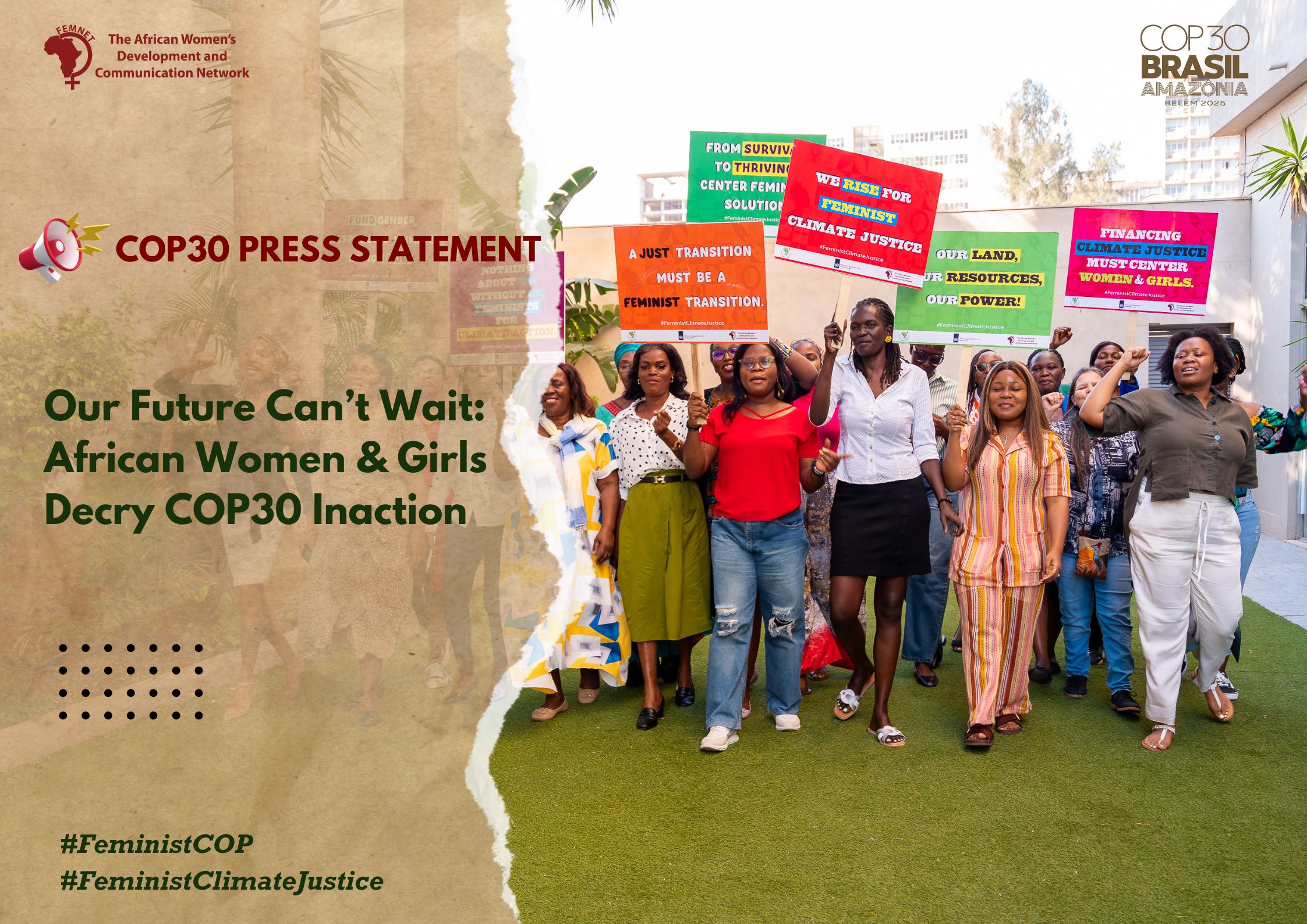
Our Future Can’t Wait: African Women and Girls Decry COP30 Inaction
21st November 2025, Liberian Pavilion (11 am Brazil Time), Belem, Brazil
Press Briefing
We gather here representing the vulnerable groups in Africa, the women, young girls, people with disability and the broader African feminist climate justice movement.
As a women organization representing frontline communities, we stand here grounded in the lived realities of our people farmers who watch the rains disappear, women walking longer distances for water, youth innovating with limited tools, and grassroots leaders who carry the true weight of climate change.
As COP30 enters its final hours, we have invited you here to speak about what is happening inside these negotiation rooms and what it means for African women and girls on the frontlines of the climate crisis.
We came to Belém with clear demands forged through our organizing from Africa Climate Summit and the Feminist Just Transition Forum in Addis Ababa to Feminist Cop in Maputo and amplified here in Brazil.
Ten years after Paris promised just transitions and climate consistent finance, we arrived not with patience, but with concrete, non-negotiable demands:
First, on Just Transition: We advocated for the Belém Action Mechanism to move from dialogue to delivery with grant-based finance, technical assistance, and meaningful participation of women, workers, and Indigenous Peoples in governance. After COP29 failed to adopt any decision on just transition, we cannot afford more talk.
Second, on Climate Finance: Ambitious, reparative, grant based climate finance accessible to grassroots women’s organizations. Currently, 80% of finance to Africa arrives as loans that deepen debt, and less than 2% reaches African women’s organizations directly.
Third, on Gender: An enhanced Gender Action Plan that redistributes power and resources, not just rhetoric. We need binding commitments on human rights, care economy integration, direct access for women’s organizations, and protection for Environmental Women Human Rights Defenders.
What’s Happening!
1. On Gender
- Gender Action Plan is heavily bracketed. Gender references are being systematically stripped from the Mitigation Work Programme and other key texts. Some parties are attempting to narrow gender definitions. This is not a mere disagreement over language. This is the system that protects itself!
- Without explicit climate finance commitments for gender, the Gender Action Plan is decorative. Without binding protections for women’s rights defenders, women will continue to be criminalized and killed for defending the climate. Without care, economic integration, transition plans ignore the labor that sustains adaptation.
2. On Climate Finance
- Of the 23% of climate finance reaching Africa, 80% arrive as loans with conditionalities that force austerity. That austerity cuts health, education, and social services. Women and girls bear the brunt. Countries service debt instead of building resilience
- Meanwhile, less than 2% of climate finance reaches African women’s organizations directly. When we demand simplified accreditation so grassroots women’s organizations can access funds directly, we’re told our fiduciary systems aren’t robust enough even though we’re the ones implementing solutions on the ground.
- On negotiations, out of the five pathways that deliver climate finance under article 9 only 1 and 2 are clear
3. On Just Transition
- The obstruction of the Belém Action Mechanism (BAM) reveals that developed countries don’t want coordination or accountability because coordination would expose that the current transition is fundamentally unjust.
- The BAM would provide technical assistance, match countries with grant-based finance, address structural barriers like debt, and ensure meaningful participation of affected communities in governance.
- You cannot build a Just Transition on unjust extraction. You cannot deliver climate justice through colonial economic structures. You cannot claim to care about Africa’s development while maintaining the debt, trade, and finance architecture that makes sustainable development impossible.
4. On Adaptation Loss and Damage
- Climate justice is impossible without addressing the escalating loss and damage confronting African women, girls, and frontline communities. The negotiations continue to fall short of meeting the scale of the crisis we face
- The adaptation gap continues to widen, leaving African countries especially womenled communities without the resources needed to respond to accelerating climate impacts. Adaptation finance remains insufficient, fragmented, and often diverted into projects that fail to reach those most affected
5. On Response Measures
Response measures, intended to address the social and economic impacts of climate ctions, remain disconnected from the daily struggles of African women and girls. Current proposals fail to recognize women’s unpaid care work, the feminization of poverty, and the gendered impacts of shifting energy markets, land use, and resource extraction.
Instead of safeguarding livelihoods, too many policies continue to reinforce extractive models that displace women, undermine local economies, and widen existing inequalities.
Our Call to Action in These Final Hours!
The next few hours will determine whether COP30 delivers transformation or just another coat of green paint on colonial violence.
1. Adopt an Enhanced Gender Action Plan with Real Accountability
COP30 must deliver an enhanced Gender Action Plan that includes measurable finance targets, clear indicators, and mandatory reporting. Gender equality cannot remain rhetorical; it requires resourcing, monitoring, and enforceable commitments.
2. Deliver Adaptation Finance to Africa as Grants with Simplified Access
Adaptation finance must be grant based, predictable, and accessible, removing the complex bureaucratic barriers that block the most affected communities especially women from receiving support. Climate finance tied to loans is unjust and deepens vulnerability.
3. Cancel Illegitimate Debt and Triple Public Climate Finance Now
We demand for the cancellation of illegitimate debt, which drains public resources urgently needed for climate resilience. Donor countries must triple public climate finance
contributions, delivered as grants, not loans, and open enhanced direct-access pathways to ensure funds reach women’s groups, communities, and local institutions on the ground.
4. Increase and Feminize the Loss and Damage Fund
The Loss and Damage Fund must be significantly expanded and made directly accessible to African women, grassroots responders, and frontline communities. This fund must recognize the real losses women face economic and non-economic and support their leadership in rebuilding lives and livelihoods.
5. Adopt the Belém Action Mechanism with Binding Commitments
We call for adoption of the Belém Action Mechanism with binding, time bound commitments that advance global equity, protect vulnerable populations, and ensure transparent implementation across all climate actions.
6. Operationalize Africa’s Special Needs and Circumstances
COP30 must formally operationalize Africa’s Special Needs and Circumstances, ensuring that the continent’s unique vulnerabilities and structural disadvantages are fully recognized in climate finance, adaptation, technology transfer, and capacity-building decisions.
7. Ensure Response Measures are Grounded in Justice and People Cantered Transition Planning
Response measures must be anchored in justice, equity, and feminist principles, protecting the livelihoods, jobs, industries, and exports that sustain African women and communities.
- African women are not victims waiting to be saved. We are not beneficiaries hoping for charity. We are rights holders demanding justice. We are solution builders implementing alternatives. We are power holders in our communities.
- What we lack is not capacity or knowledge. What we lack is access to the resources that have been extracted from our continent for centuries and the decision-making power that has been systematically denied.
Thank you.
For more information contact:
Anne Tek: a.tek@femnet.or.ke and Zukiswa White: FNTCon.Zukiswa@femnet.or.ke